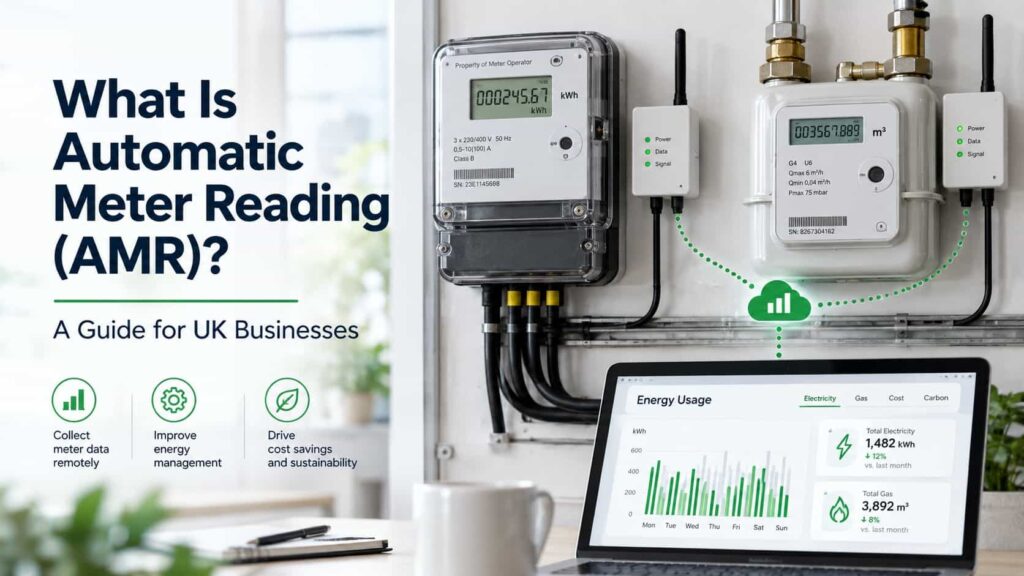
Reading an energy meter used to mean physically finding the meter, writing down the number and sending the reading to an energy supplier.
Automatic Meter Reading changes that process.
AMR technology allows consumption information to be collected from a meter remotely and transferred to another system without somebody having to visit the meter each time.
For businesses, that can mean fewer manual readings, better consumption data, more accurate billing and much greater visibility of when energy is being used.
But AMR is also one of the more confusing parts of commercial energy metering.
You may see references to Automatic Meter Reading, Automated Meter Reading, Advanced Meter Reading, smart meters, half-hourly meters and Advanced Metering Infrastructure.
They are related concepts, but they do not all mean exactly the same thing.
What is Automatic Meter Reading?
Automatic Meter Reading, usually shortened to AMR, is technology used to collect meter readings remotely.
Instead of a person visiting the meter, consumption information is sent through a communications system to a supplier, data provider or energy monitoring platform.
AMR can be used with utilities including:
- Electricity
- Gas
- Water
- Heat
- Steam
- Other measurable utilities
- The precise equipment varies depending on the meter and utility.
In some cases, communication capability is built into the meter.
In others, an additional data logger or communications device is connected to an existing meter.
The principle remains the same.
The meter records consumption and the reading is collected remotely.
Automatic, automated or advanced meter reading?
You may see AMR expanded in several ways.
Automatic Meter Reading and Automated Meter Reading are both widely used terms.
In the UK non-domestic energy market, government and industry documents may also use Advanced Meter Reading when discussing certain advanced business meters.
This can make terminology confusing.
For most facilities and energy-management purposes, the important point is not which version of the acronym is being used.
The important questions are:
- What does the meter measure?
- How frequently does it record data?
- Can readings be collected remotely?
- Who receives the data?
- Can the business access it?
- Can it be integrated into a monitoring platform?
Those questions determine how useful the metering arrangement actually is.
How does AMR work?
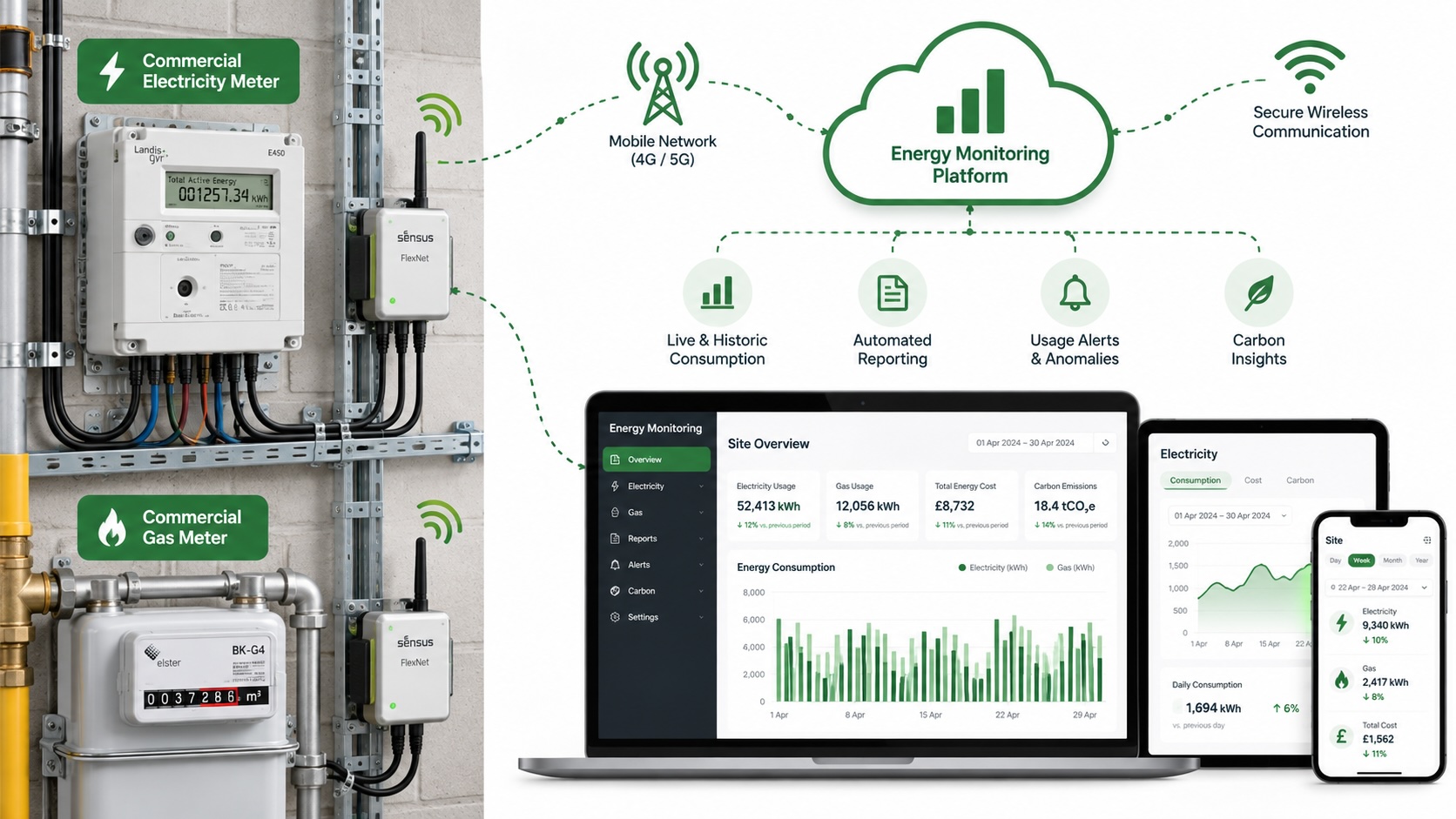
A basic AMR system contains several stages.
First, the meter measures consumption.
The meter or associated device then records the reading.
A communications system transfers the information remotely.
The readings arrive at a central data system.
From there, the data can be used for purposes such as:
- Billing
- Energy monitoring
- Reporting
- Tenant re-billing
- Portfolio management
- Consumption analysis
- Carbon reporting
The communication method depends on the metering system.
It may use mobile communications, wired networks, radio, data loggers, gateways or other technologies.
AMR electricity meters
Electricity AMR can provide much more useful information than a single monthly reading.
Depending on the meter, readings may be recorded at regular intervals.
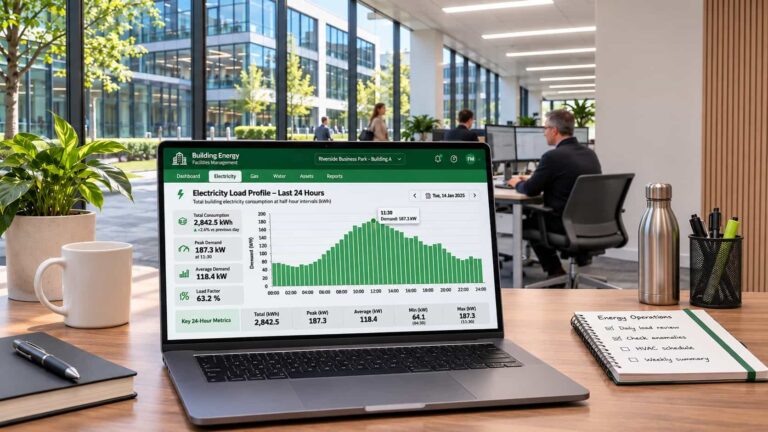
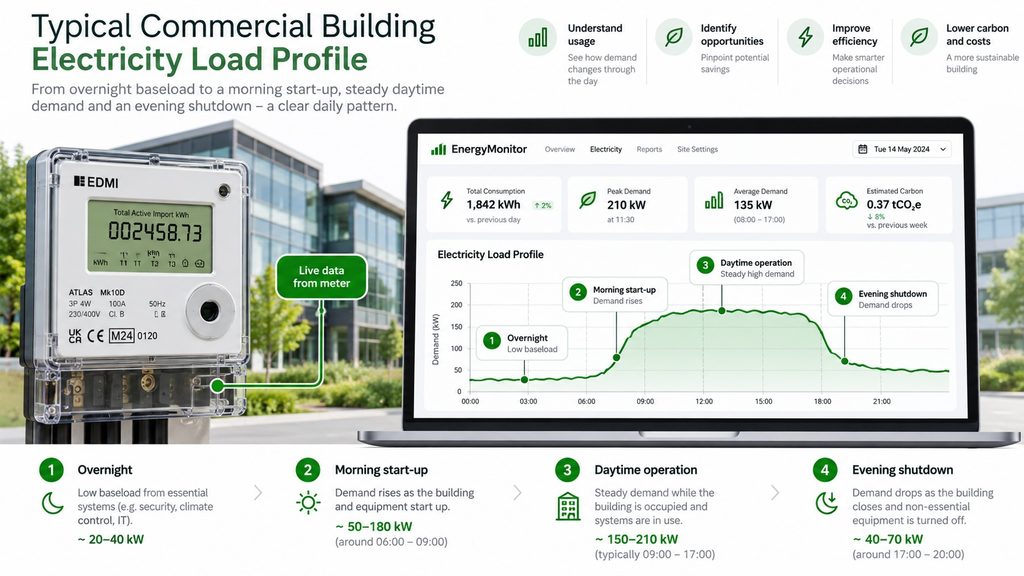
Half-hourly electricity data is particularly useful for commercial buildings because it divides each day into 48 consumption periods.
That creates a load profile.
Instead of seeing only the total electricity used during the month, the business can see how consumption changes throughout each day.
This can reveal patterns such as:
- Morning start-up
- Daytime operating load
- Peak demand
- Evening shutdown
- Overnight baseload
- Weekend consumption
- Unexpected changes in usage
The data becomes useful for much more than billing.
AMR gas meters
AMR is also widely used for gas.
Depending on the arrangement, a communications device may be attached to an existing gas meter or included as part of the metering system.
Remote gas readings can make it easier to track consumption without sending somebody to a plant room or meter location.
For buildings using gas for heating, interval data can also help explain seasonal and operational patterns.
For example, an organisation might compare:
- Gas consumption against outside temperature
- Weekday and weekend usage
- Heating-season consumption
- Different buildings across an estate
- Consumption before and after plant changes
This can make gas monitoring much more informative than relying purely on monthly bills.
AMR versus manual meter reading
The most obvious difference is how the reading is collected.
Manual meter reading requires a person to visit the meter.
AMR collects the information remotely.
For one easily accessible meter, the difference may appear small.
For an organisation managing 200 meters across 40 sites, it becomes substantial.
Manual reading creates several practical problems.
Meters may be difficult to access.
Readings may be taken on inconsistent dates.
Individual meters may be missed.
Numbers can be entered incorrectly.
Staff time is required.
Data may only be collected monthly.
AMR reduces many of these problems.
AMR versus a smart meter
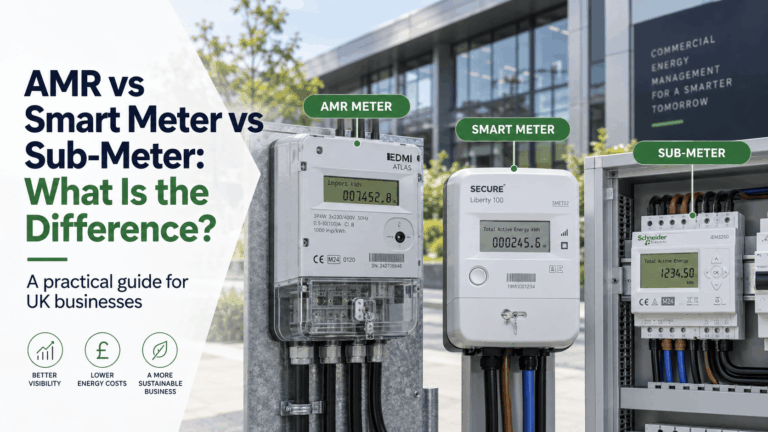
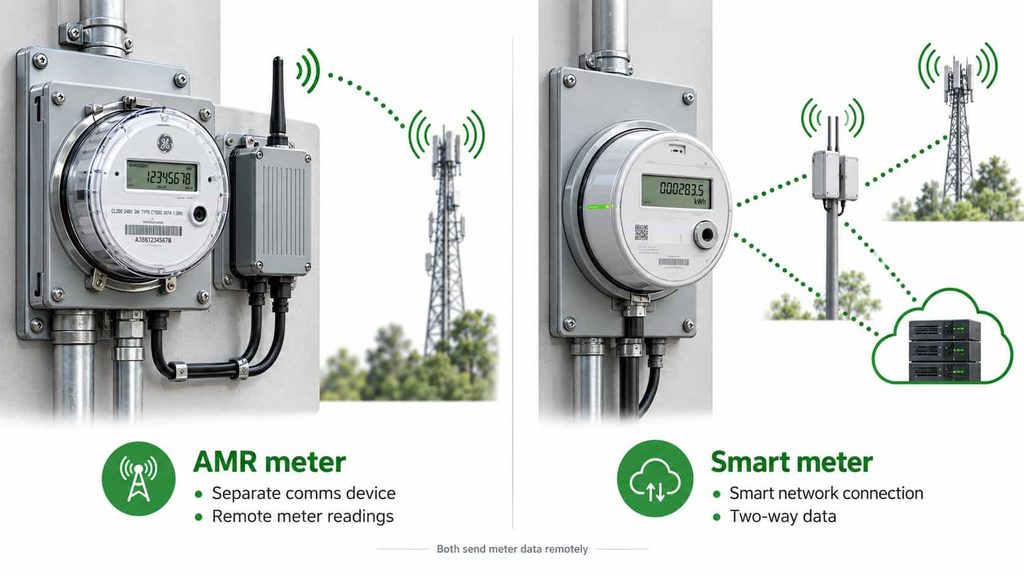
AMR meters and smart meters both provide remote readings, which is why the terms are often confused.
The technical and market arrangements can be different.
UK smart meters generally operate within the national smart-metering framework and meet defined technical specifications.
AMR arrangements can use different communications systems and are common in the commercial and industrial market.
A traditional distinction is also that AMR primarily sends data from the meter towards the collection system, while modern smart-metering infrastructure can support wider two-way communications.
However, from the perspective of an energy manager, both technologies may provide useful consumption data.
The practical question is what data is available and whether it can be accessed.
AMR versus Advanced Metering Infrastructure
AMR is not the same as Advanced Metering Infrastructure, or AMI.
AMR describes the remote collection of meter readings.
AMI describes the wider infrastructure that can connect advanced meters, communications networks, central data-management systems and software.
A simple way to think about the relationship is:
AMR automates the reading.
AMI connects the wider metering system.
A business does not necessarily need a complete utility-scale AMI system to benefit from automatic meter data.
Existing AMR meters can often provide valuable information when their data is brought into an appropriate energy-monitoring platform.
Why businesses use AMR
The first benefit is convenience.
Meters no longer need to be visited simply to obtain routine readings.
But the greater benefit is the information that becomes available once readings are collected regularly.
AMR can support:
- More accurate billing
- Regular consumption data
- Reduced reliance on estimates
- Half-hourly energy analysis
- Multi-site monitoring
- Tenant billing
- Energy-cost allocation
- Identification of unusual consumption
- Energy reporting
- Measurement of savings
- Budgeting and forecasting
The value depends on what happens after the readings are collected.
AMR and accurate energy billing
Estimated bills can occur when suppliers do not have reliable meter readings.
Automatic readings reduce reliance on manual submissions and can help provide more current consumption information.
For businesses with significant energy use, this can improve the relationship between actual consumption and billing.
It can also make it easier to investigate unusual bills because historic meter data is available for comparison.
However, AMR should not be assumed to make every bill automatically correct.
Tariffs, standing charges, taxes and other billing components still need to be correct.
AMR improves the consumption data used within that wider billing process.
AMR and energy monitoring
This is where automatic meter data becomes particularly useful.
Consider a supermarket using 30,000 kWh of electricity in a month.
That number is useful.
But it does not show whether most of the electricity was used during trading hours or whether substantial consumption continued overnight.
Half-hourly AMR data can show the shape of usage across each day.
An energy manager might notice that electricity consumption remains unusually high between midnight and 5am.
The next question becomes: why?
Possible sources might include:
- Refrigeration
- Lighting
- Ventilation
- Heating or cooling
- Electric water heating
- IT equipment
- Other plant
- The AMR data does not necessarily identify the exact equipment.
It identifies the time and scale of the consumption so somebody can investigate.
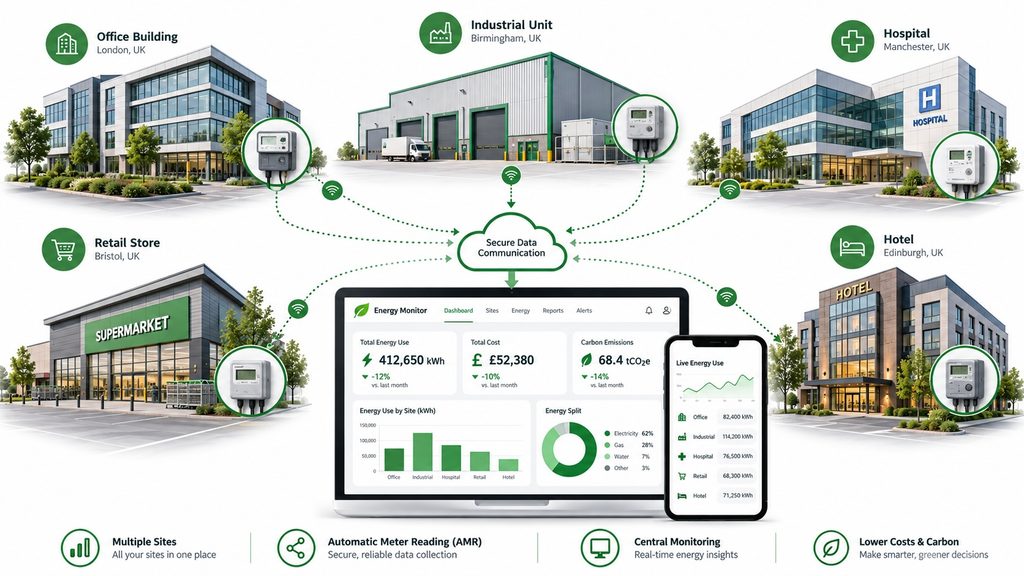
Monitoring several buildings from one place
AMR becomes particularly useful for multi-site organisations.
Without centralised data collection, an estates team might need to log into several supplier portals, request spreadsheets or collect meter readings independently from each building.
A central monitoring system can bring the readings together.
This allows organisations to compare buildings using consistent reporting.
For example, a company operating 30 branches could compare:
- Total electricity consumption
- Consumption per square metre
- Overnight baseload
- Weekend consumption
- Month-on-month changes
- Peak demand
- Sites with unusual patterns
A poorly performing building becomes much easier to identify when it can be compared with similar sites.
Third-party AMR data
A common misconception is that businesses need to replace every existing meter before they can centralise their energy data.
That is not always true.
Many organisations already have AMR installed through energy suppliers or metering providers.
The problem is often that the information exists in several separate systems.
Third-party AMR data may be capable of being collected and brought into a central energy platform, depending on the provider and available data arrangements.
This can be particularly valuable for organisations with:
- Several suppliers
- Multiple buildings
- Different meter types
- Large meter estates
- Changing energy contracts
The objective is to create one useful view of consumption rather than another disconnected source of data.
AMR and utility sub-metering
AMR is not limited to the main utility meter.
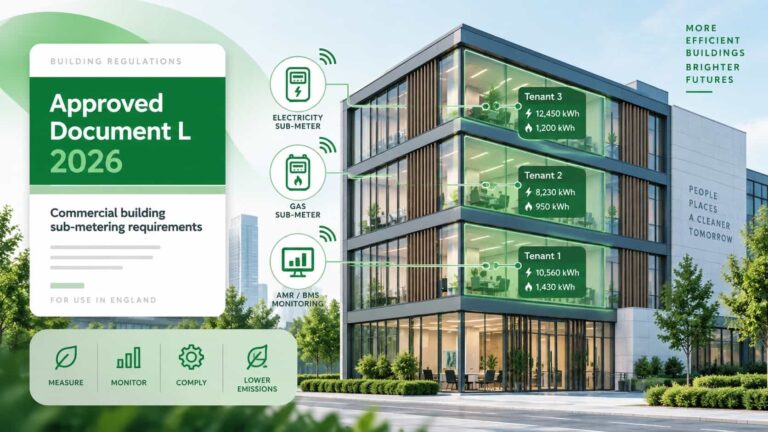
Sub-meters can also be connected to automatic data-collection systems.
For electricity, this might include individual:
- Tenant areas
- Floors
- Distribution boards
- HVAC systems
- Production lines
- EV chargers
- Large equipment
For other utilities, organisations may automatically collect data from:
- Water sub-meters
- Heat meters
- Gas sub-meters
- Steam meters
- Oil meters
- Other utility measurement points
This creates a much more detailed picture of where resources are being used.
AMR for landlords and tenant re-billing
Commercial landlords may use sub-metering to separate tenant consumption from communal usage.
Automatic readings can simplify this process considerably.
Rather than visiting every meter at the end of a billing period, consumption data can be collected centrally.
This can support:
- Tenant consumption reports
- Utility cost allocation
- Re-billing
- Landlord-versus-tenant comparisons
- Communal-area monitoring
- Portfolio reporting
The reliability of the underlying data is particularly important when meter readings have a financial consequence.
Meter identification, commissioning and data checking should therefore be treated seriously.
What happens if an AMR meter stops communicating?
Remote readings depend on communications.
If that connection fails, the meter may continue measuring energy while the central system stops receiving data.
This can create gaps.
A good monitoring system should make missing readings visible rather than quietly leaving blank periods in reports.
The issue can then be investigated.
Possible causes include:
- Mobile-network problems
- Gateway failure
- Meter faults
- Power loss
- Configuration changes
- Communication hardware failure
- Replacement meters
- Building-network changes
This is why data monitoring matters as much as meter installation.
Data quality matters
Automatic data is not automatically accurate data.
A reading can arrive successfully and still be wrong.
Meters may be incorrectly configured.
Current transformers may be installed incorrectly.
Units can be misunderstood.
Meter identifiers can be associated with the wrong building.
Data may be duplicated.
A meter may have been replaced without the central platform being updated.
Validation is therefore an important part of energy data management.
Where possible, readings should be checked against known totals and expected consumption patterns.
Can AMR reduce energy costs?
AMR itself does not reduce consumption.
It provides information.
Savings occur when somebody uses that information to change the way energy is consumed.
For example, AMR data might reveal that an office ventilation system operates for three unnecessary hours every morning.
The controls are adjusted.
Electricity consumption falls.
The AMR meter did not save the electricity.
It provided the evidence needed to identify the problem.
This distinction matters when evaluating any energy-monitoring system.
The value comes from measurement followed by action.
What should you consider before installing or expanding AMR?
Start with the business requirement.
Ask:
- Which utilities need monitoring?
- What meters already exist?
- Is AMR already available?
- How frequently is data required?
- Do we need half-hourly information?
- Will the data support tenant billing?
- How many sites need to be monitored?
- Where will readings be stored?
- Can third-party meter data be integrated?
- Who will review the information?
- Do we need alerts for missing or abnormal consumption?
- Does the system need to integrate with a BMS?
The answers will determine whether new hardware is needed or whether better use can be made of the data already available.
Automatic Meter Reading is the start of the process
The biggest advantage of AMR is not simply eliminating manual readings.
It is making regular consumption data available.
Once readings are collected automatically, businesses can start to understand when energy is being used, compare buildings, investigate abnormal consumption and monitor the impact of energy-saving measures.
For a single small meter, the difference may be modest.
Across a large commercial building or multi-site estate, automatic readings can fundamentally change the amount of information available to facilities and energy teams.
But collecting the data is only the first step.
The real value comes from organising it, checking it and using it to understand how the building or estate actually consumes energy.