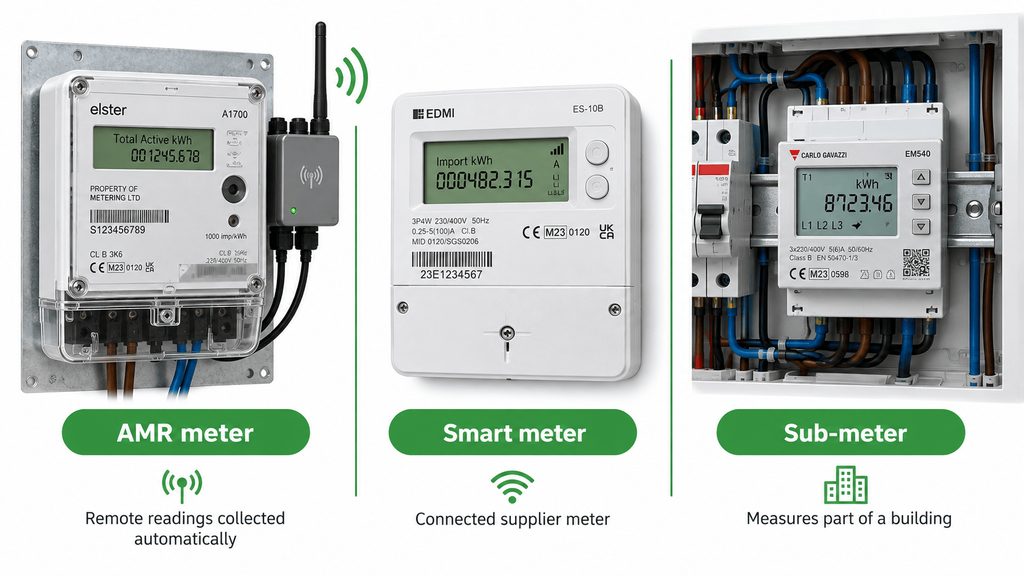
AMR meters, smart meters and sub-meters are often discussed as though they are three versions of the same technology.
They are not.
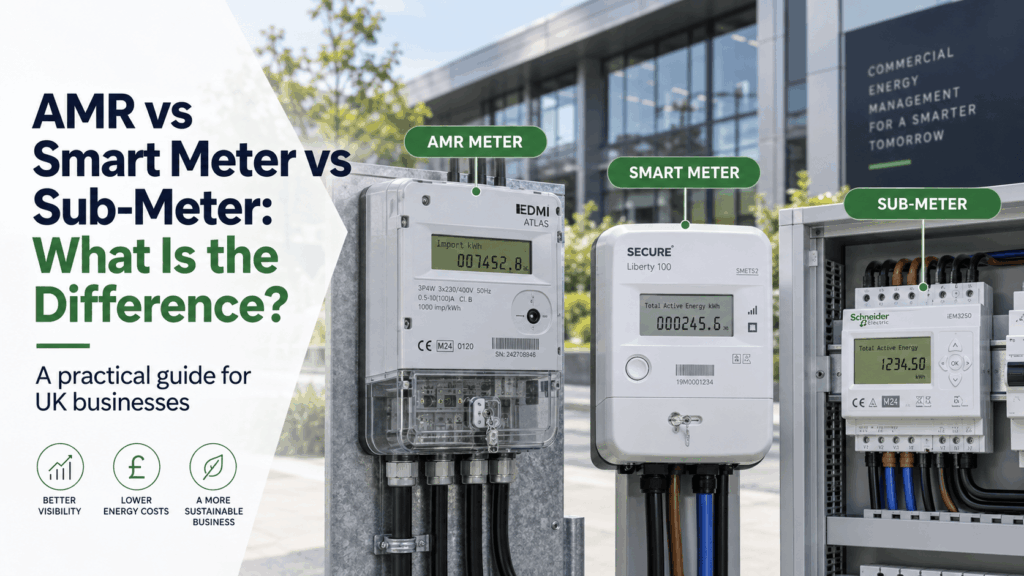
A smart meter and an AMR meter primarily describe how meter readings are collected and communicated. A sub-meter describes where additional measurement takes place within a building or site.
That distinction matters for businesses because a property can contain all three.
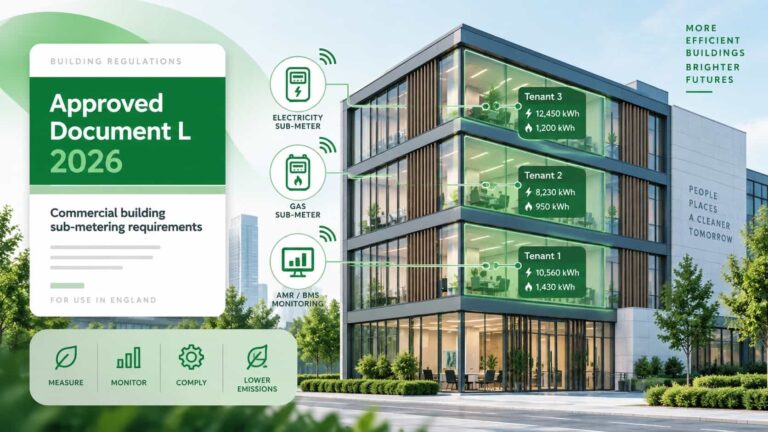
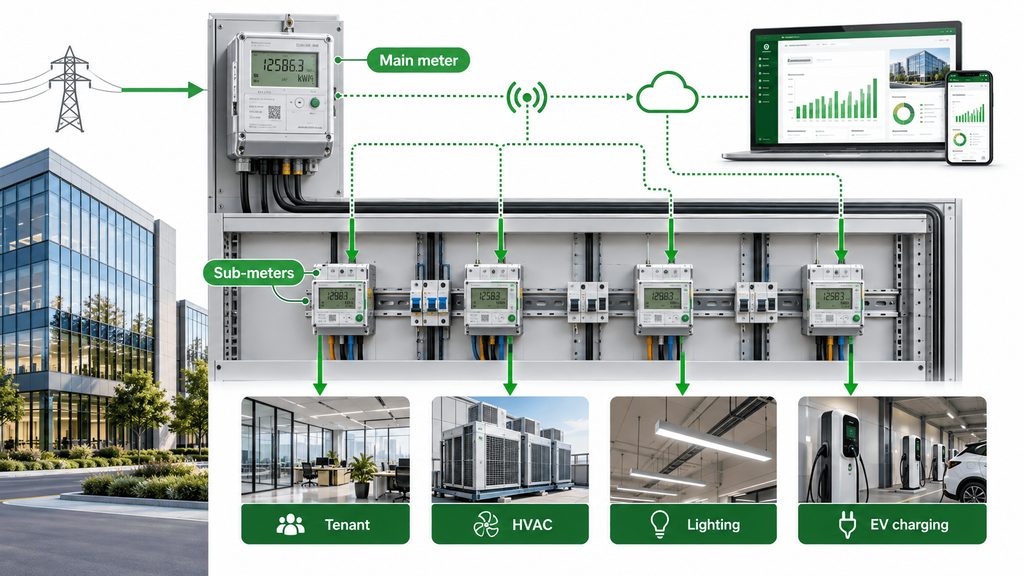
A commercial building might have a smart or advanced meter measuring the incoming electricity supply, AMR equipment collecting data remotely, and dozens of sub-meters measuring individual tenants, floors, plant or electrical circuits.
Understanding what each does makes it much easier to design a useful energy monitoring system.
What is an AMR meter?
AMR stands for Automatic Meter Reading, Automated Meter Reading or, in some UK non-domestic contexts, Advanced Meter Reading.
The basic purpose is the same: meter readings are collected remotely instead of requiring somebody to visit the meter.
An AMR system typically includes a meter or meter interface, communications equipment and a system that receives the readings.
Depending on the installation, data may be transmitted using mobile networks, wired communications, radio, gateways or other technologies.
The key point is that the reading process is automated.
This is particularly useful for businesses with many meters or sites.
Reading three meters manually may be manageable. Reading several hundred meters spread across an estate quickly becomes inefficient.
AMR allows those readings to be collected more consistently and often at much shorter intervals.
What is a smart meter?
A smart meter is an electricity or gas meter designed to record consumption and communicate readings remotely.
In Great Britain, smart metering also refers to a specific national metering framework used extensively in homes and smaller non-domestic premises.
Smart meters can send readings automatically and may provide much more detailed consumption information than traditional meters.
For a business, this can reduce reliance on estimated readings and make energy data easier to access.
However, simply having a smart meter does not automatically mean that a company is actively monitoring its energy consumption.
The meter may be collecting detailed information while the organisation still only looks at the monthly bill.
The value comes from using the data.
What is an advanced meter?
Larger non-domestic energy users may encounter the term advanced meter rather than smart meter.
Advanced meters have been widely used in commercial and industrial energy supply for many years.
They can remotely provide detailed consumption data and may support half-hourly readings.
The exact regulatory distinction between smart and advanced meters matters to suppliers and the electricity market, but facilities managers usually have a more practical question:
What data can I access?
If the meter provides useful interval data that can be brought into an energy monitoring platform, it can become a valuable source of information regardless of the terminology used to describe it.
What is a sub-meter?
A sub-meter is different.
It is an additional meter installed downstream of the main utility meter to measure a specific part of a building or site.
Imagine a commercial property with one incoming electricity supply.
The main meter measures everything entering the building.
That total might include lighting, air conditioning, lifts, tenant areas, EV charging, server equipment and other electrical loads.
If the building owner wants to understand those loads separately, sub-meters can be installed at appropriate points within the electrical distribution system.
A sub-meter might measure:
- an individual tenant
- a floor
- a distribution board
- HVAC equipment
- lighting
- EV charging
- a production line
- a large item of plant
The purpose is to divide total consumption into useful areas.
Can a sub-meter also have AMR?
Yes.
This is where the terminology often becomes confusing.
A sub-meter describes what is being measured.
AMR describes how the reading is collected.
An electricity sub-meter could therefore be read manually or connected to an automatic meter-reading system.
A commercial building might contain 50 electrical sub-meters, all transmitting readings automatically to one central monitoring platform.
Those meters remain sub-meters because of their position within the electrical system.
Their readings are simply being collected using AMR technology.
Smart meter vs AMR meter
Smart meters and AMR meters overlap in what they can achieve.
Both can provide remote consumption readings.
However, they are not necessarily part of the same communications infrastructure.
Traditional AMR systems are common throughout the commercial energy market and may use independent data loggers, mobile communications or other systems.
Smart meters operate within defined smart-metering arrangements and can support wider functionality.
For an energy manager, the most useful comparison is often not the technology label but the data available from it.
Ask whether the meter provides interval readings, how frequently those readings are collected, whether historic data is available and whether the information can be exported or integrated into another system.
Main meter vs sub-meter
This is another important distinction.
The main electricity meter measures the total electricity supplied to the site.
Sub-meters divide that total into smaller areas.
For example, suppose the main meter records 100,000 kWh during a month.
Electrical sub-metering might reveal that:
40,000 kWh was used by tenants
25,000 kWh was used by heating, ventilation and cooling
12,000 kWh was used by lighting
8,000 kWh was used by EV charging
The remaining consumption may be associated with lifts, communal areas, equipment or other loads.
The main meter gives the total.
Sub-metering starts to explain the total.
Which meter is used for billing?
The utility meter is normally associated with the energy supplied by the energy supplier.
Sub-meters are generally installed within the customer’s side of the building infrastructure.
They can be used to support internal cost allocation or tenant re-billing where the appropriate arrangements are in place.
This is common in multi-tenanted commercial buildings.
A landlord may receive one electricity bill for the entire property while using sub-meters to establish how much electricity was consumed by individual occupiers.
Separate landlord meters can also measure communal areas.
This provides a much clearer basis for understanding building consumption than dividing costs solely according to floor area.
Why businesses often need more than one type of metering
A single smart or AMR meter at the incoming supply can provide excellent data.
But it still measures the entire building.
If consumption suddenly rises by 20%, the main meter will show the increase.
It may not explain what caused it.
Sub-metering creates additional detail.
If the increase appears only on the HVAC sub-meter, the facilities team immediately has a narrower area to investigate.
This is why main metering, AMR and sub-metering often work best together.
The main meter provides the overall picture.
Sub-meters explain individual areas.
Automatic data collection makes both easier to monitor.
What is the role of half-hourly data?
Interval data makes metering considerably more useful.
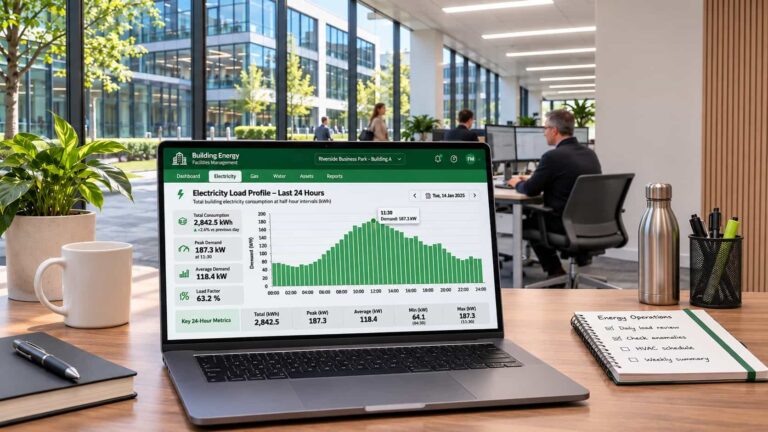
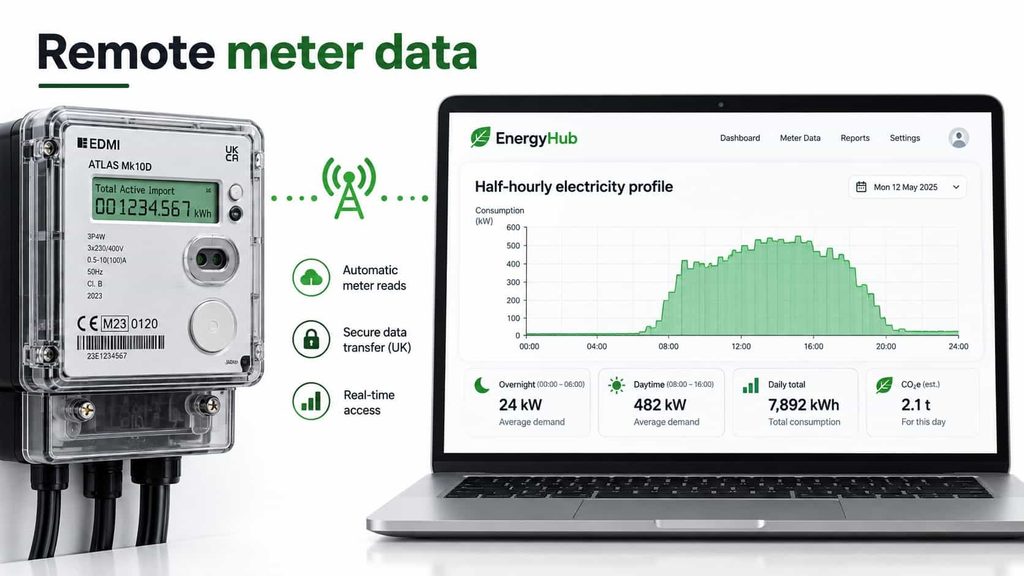
Half-hourly electricity data provides 48 consumption periods every day.
Instead of seeing only how much electricity was used during a month, a facilities manager can see when it was used.
This can reveal:
- early morning equipment starts
- overnight baseload
- weekend consumption
- sharp demand peaks
- changes in operating schedules
- unusual increases in consumption
A meter that provides frequent readings can therefore become an operational tool rather than simply a billing device.
How does this fit with Advanced Metering Infrastructure?
Advanced Metering Infrastructure, or AMI, describes the wider connected system around advanced meters.
It can include meters, communications networks, data collection, meter data management and monitoring software.
AMR is one part of this broader picture.
Sub-meters may also feed into the same infrastructure.
A sophisticated commercial energy monitoring system might therefore combine data from supplier meters, smart meters, AMR systems and internal sub-meters.
The objective is not to force every meter into one technical category.
It is to create a reliable view of energy consumption.
What should a business check first?
Before replacing meters, it is worth understanding what is already installed.
Many businesses have useful meter data available but are not using it effectively.
An initial review should establish which meters exist, what each one measures, whether readings can be collected remotely and where the resulting data is stored.
It is also worth checking whether existing supplier or third-party AMR data can be accessed.
The organisation may discover that much of the information it needs is already available.
Which is better: AMR, smart meter or sub-meter?
There is no single winner because they perform different jobs.
If the objective is remote collection of existing meter readings, AMR may provide the answer.
If a smaller business is receiving a modern supplier meter, a smart meter may provide detailed consumption data automatically.
If the question is where electricity is being consumed inside a building, sub-metering is likely to be required.
Large commercial properties often need a combination of all three concepts.
The important question is therefore not:
Which meter is best?
It is:
What do we need to understand?
Once that question is clear, the appropriate metering and monitoring arrangement becomes much easier to design.
Better metering starts with better questions
Meter terminology can make energy monitoring appear more complicated than it needs to be.
AMR is about collecting readings remotely.
Smart metering provides connected consumption data through established smart-metering systems.
Sub-metering breaks a building’s total consumption into useful parts.
Used together, they can provide a detailed picture of how a commercial property consumes energy.
The technology matters, but the purpose matters more.
A good metering system should help a business understand what it uses, where it uses it, when it uses it and what has changed.
That is the information that turns meter readings into useful energy management.