Energy metering in a commercial building should tell you more than the total amount of electricity or gas entering the property.
A useful metering system should help identify where energy is being consumed, how different building services are performing, how much individual tenants are using and whether actual consumption matches what was expected when the building was designed.
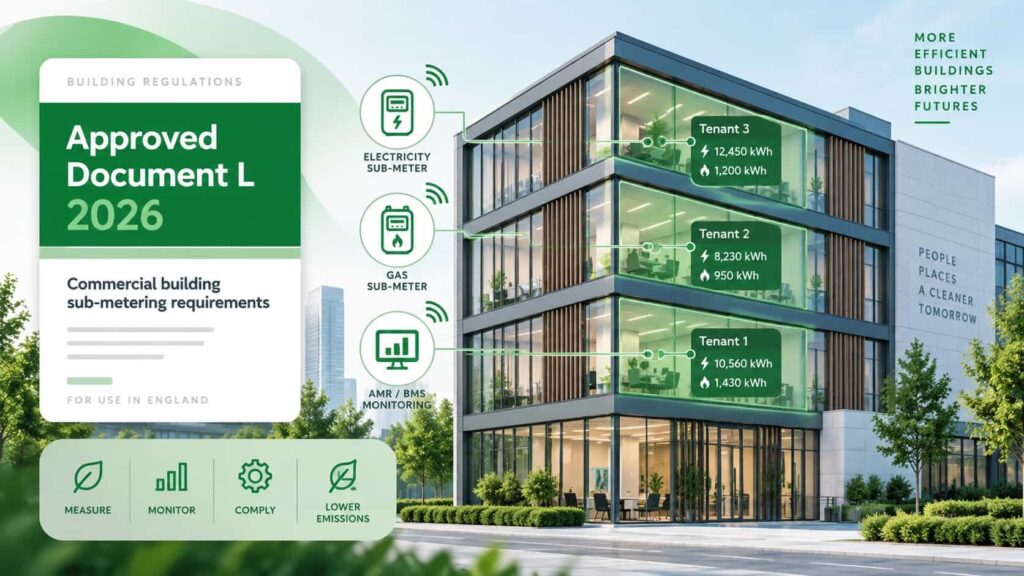
This is reflected in the 2026 edition of Approved Document L, Volume 2, which covers buildings other than dwellings in England.
The guidance includes specific requirements around energy sub-metering, tenant consumption, renewable energy monitoring and automatic meter reading.
For developers, landlords, facilities managers, building services engineers and property managers, this makes the design of the metering system an important part of building energy performance.
What is Approved Document L?
Approved Document L provides guidance on meeting the energy and greenhouse gas emission requirements of Part L of the Building Regulations in England.
Volume 2 applies to buildings other than dwellings.
This includes many types of commercial and public buildings, such as:
- Offices
- Retail buildings
- Industrial premises
- Warehouses
- Schools and universities
- Hotels
- Leisure facilities
- Healthcare buildings
- Mixed-use commercial properties
The 2026 edition introduces updated standards for buildings subject to the new requirements.
One area that deserves particular attention is energy sub-metering.
What does Part L say about energy sub-metering?
Approved Document L states that energy sub-metering systems should be installed in new buildings or when fixed building services are provided or extended in an existing building.
The guidance sets out several objectives for the metering system.
These include being able to assign at least 90% of annual energy consumption for each fuel to an end use, measure the energy use of individual tenants and monitor renewable energy systems separately.
For buildings with a total useful floor area greater than 1,000 square metres, automatic meter reading and data collection facilities should also be installed.
This means that a single incoming utility meter will often not provide enough information.
The building may require a structured sub-metering system capable of separating significant loads and making that data available for monitoring and reporting.
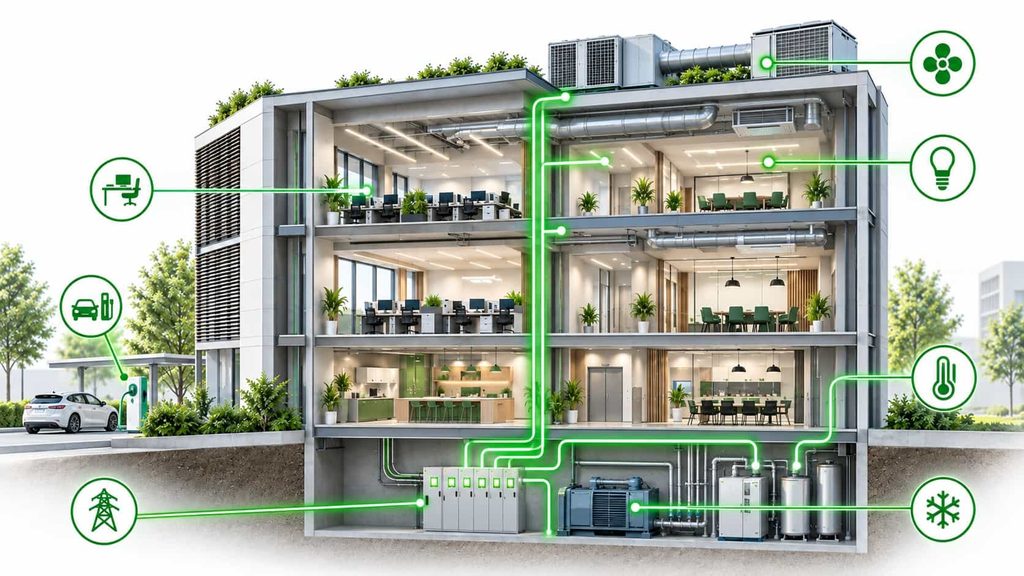
What does the 90% energy sub-metering requirement mean?
One of the most important points in Approved Document L is that the various end-use categories should be sub-metered so that at least 90% of the annual consumption of each fuel can be assigned to an end use.
The aim is to understand what is actually consuming energy within the building.
Consider a commercial property using 600,000 kWh of electricity each year.
The main electricity meter can tell the building owner that 600,000 kWh was consumed.
It cannot necessarily explain how that electricity was divided between:
- Heating
- Cooling
- Ventilation
- Lighting
- IT equipment
- Commercial kitchens
- Lifts
- Electric vehicle charging
- Tenant areas
- Process equipment
- Other major electrical loads
A properly designed electrical sub-metering system can provide this additional level of detail.
The requirement does not mean every socket, light fitting or individual appliance needs its own meter.
The purpose is to create a sensible metering strategy that accounts for the major energy uses within the building.
Why does Part L refer to CIBSE TM39?
Approved Document L refers to CIBSE TM39 for detailed guidance on building metering.
TM39 is an established industry guide covering the design, installation, commissioning and use of building metering and monitoring systems.
The 2026 edition has a wider scope than earlier versions and covers electricity, thermal energy, water and steam metering.
This is useful because modern commercial buildings increasingly need to understand more than electricity and gas consumption alone.
A large property might contain:
- Electrical sub-meters
- Gas meters
- Water meters
- Heat meters
- Steam meters
- Renewable generation meters
- Tenant meters
- EV charging meters
- Data from building management systems
The challenge is not simply installing these devices.
It is ensuring the metering strategy produces data that can actually be used.
Why does individual tenant metering matter?
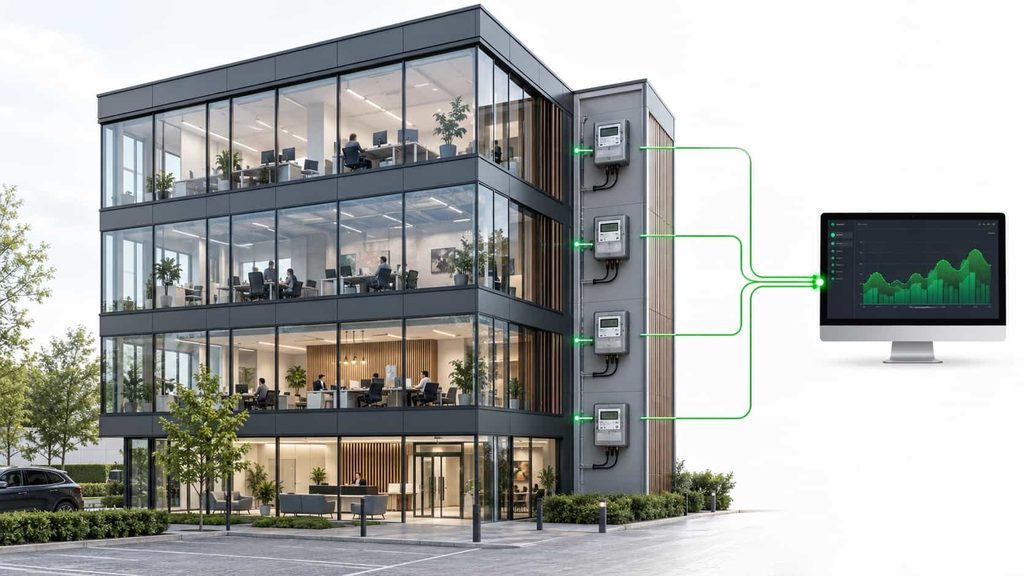
Approved Document L also states that metering should measure the energy use of each tenant within the building.
This is particularly relevant to multi-tenanted commercial properties.
Imagine two businesses occupying similar-sized units.
One operates between 9am and 5pm, Monday to Friday.
The other operates for longer hours and uses energy-intensive equipment.
Dividing the electricity bill purely according to floor area would not accurately reflect how the two spaces are being used.
Tenant sub-metering provides a direct measurement of consumption.
Depending on the property, separate metering may be required for electricity, gas, heat, water or other utilities.
The data can then support tenant energy reporting and, where the metering arrangements are suitable, utility cost allocation and re-billing.
It also gives landlords a clearer distinction between tenant consumption and energy used in communal areas.
Measuring communal energy use
Tenant metering is only part of the picture.
Commercial landlords may also need to understand energy consumption in shared areas.
This could include:
- Reception areas
- Corridors
- Shared lighting
- Lifts
- Heating and cooling plant
- Car parks
- External lighting
- Communal kitchens
- Ventilation
- Shared EV charging infrastructure
Separating landlord and tenant consumption can make property energy management considerably clearer.
Instead of seeing one building-wide energy figure, the landlord can understand what is being consumed by individual occupiers and what is associated with operating the common parts of the property.
This can also make unusual consumption easier to identify.
What is automatic meter reading?
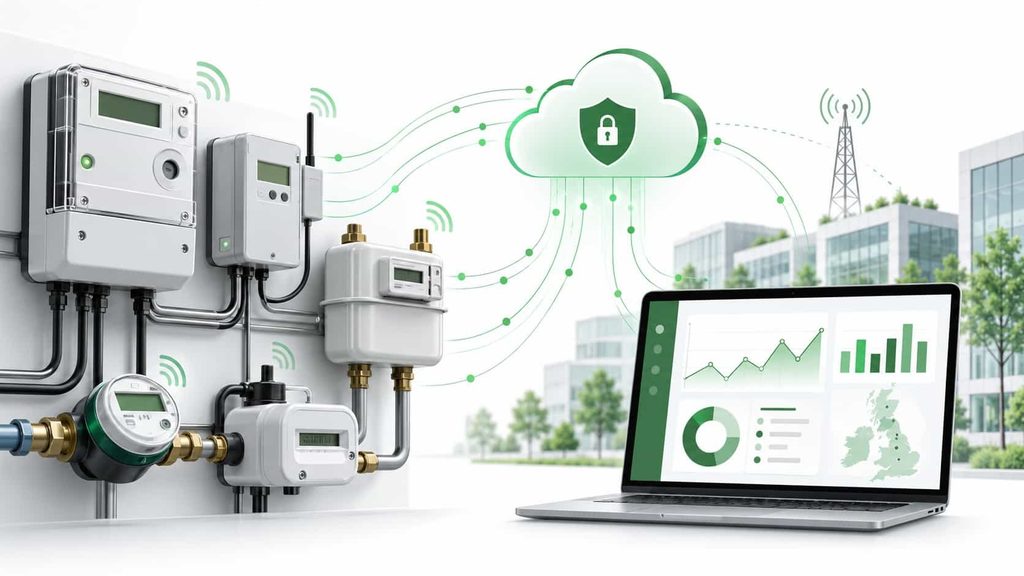
Automatic Meter Reading, usually shortened to AMR, allows meter readings to be collected remotely rather than requiring somebody to physically visit each meter.
This becomes increasingly important as the number of meters grows.
A small property with three meters might be manageable manually.
A commercial estate containing hundreds of electricity, gas, water and heat meters is a different proposition.
Manual readings take time and can lead to gaps, transcription errors and inconsistent reading dates.
AMR allows consumption information to be collected automatically and transferred into a central system.
This can provide more regular data and make portfolio-wide energy monitoring much more practical.
The 1,000 m² requirement
Approved Document L states that buildings with a total useful floor area greater than 1,000 square metres should have automatic meter reading and data collection facilities.
The important part here is not simply the installation of AMR equipment.
The data needs somewhere useful to go.
A good system should make it possible to collect, organise and review meter readings without requiring facilities teams to work through separate spreadsheets or multiple supplier portals.
For larger buildings, automated data collection can support:
- Regular energy reporting
- Consumption comparisons
- Building benchmarking
- Tenant reporting
- Cost allocation
- Identification of abnormal consumption
- Investigation of out-of-hours energy use
- Energy-saving projects
- Carbon reporting
The meter creates the measurement.
The monitoring system turns the measurement into usable information.
Why interval data is more useful than monthly totals
Monthly energy consumption is useful for tracking overall costs and long-term trends.
It is much less useful when trying to understand how a building behaves during the day.
Interval data can show when electricity is being consumed.
For example, half-hourly electricity data provides 48 readings for every day.
This makes it possible to see patterns that would be hidden within a monthly bill.
A facilities manager might discover that electricity consumption begins increasing at 4am even though staff do not arrive until 8am.
Another property may show a substantial base load throughout the night.
A third might show high electricity demand every weekend despite the building being largely unoccupied.
The total monthly consumption tells you how much electricity was used.
Interval data helps explain when it was used.
That distinction can be extremely useful when investigating energy waste.
Monitoring renewable energy separately
Approved Document L also says that the output from renewable energy systems should be monitored separately.
This becomes increasingly relevant as commercial buildings add technologies such as solar photovoltaic systems.
If a building generates its own electricity, understanding overall grid consumption alone does not provide a complete picture.
Building managers may want to know:
- How much electricity was generated?
- How much was consumed on site?
- How much was exported?
- When did generation peak?
- How closely did generation match building demand?
- Has system performance changed?
Separate renewable energy monitoring provides the data needed to answer those questions.
As buildings increasingly combine grid electricity, solar PV, EV charging, battery storage and other technologies, metering strategies are becoming more important rather than less.
Sub-metering should start with questions
It can be tempting to approach sub-metering by installing meters wherever there is space.
A better starting point is to decide what the organisation needs to understand.
For example:
- Where is most of our electricity being consumed?
- Can we separate landlord and tenant usage?
- Which building services are responsible for our energy demand?
- Are our renewable systems producing what we expected?
- Can we identify out-of-hours consumption?
- Do we need to allocate energy costs between departments?
- Can we compare similar buildings across an estate?
- Do we need automatic readings?
- How will the information be accessed?
- A good metering strategy should be designed around questions like these.
There is little benefit in collecting thousands of readings if nobody knows what the data represents or how it will be used.
Sub-metering and building energy monitoring
Sub-metering becomes much more useful when it forms part of a wider energy monitoring system.
Meters generate raw measurements.
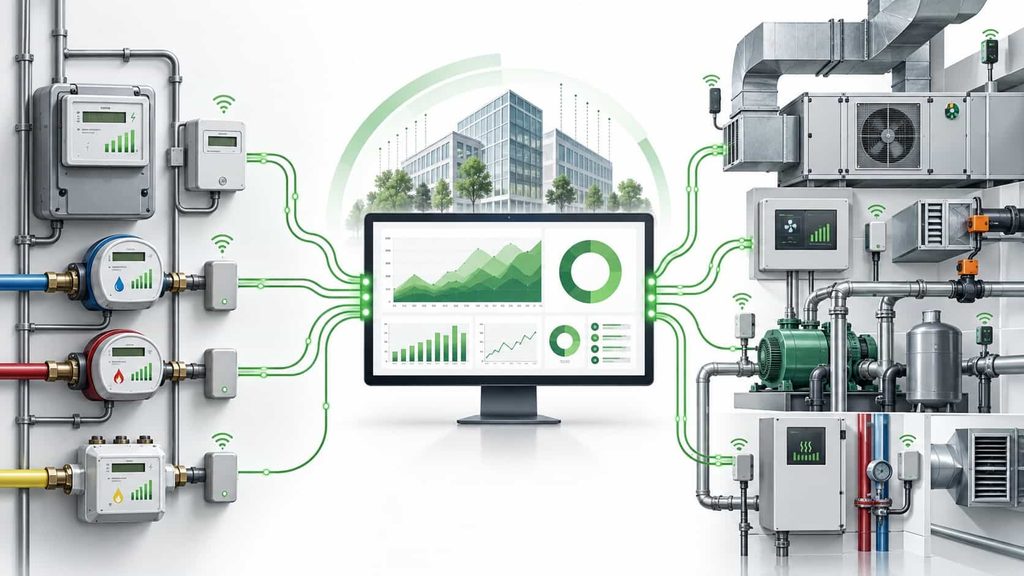
An energy monitoring platform can bring those measurements together and turn them into understandable information.
Rather than looking at separate meter readings, a facilities team might see:
- Daily and monthly consumption
- Half-hourly load profiles
- Consumption by tenant
- Consumption by building
- Electricity use by major plant
- Current and historical comparisons
- Missing meter data
- Unusual consumption patterns
- Multi-site comparisons
- This is particularly useful for organisations managing multiple buildings.
Data from different meters and sites can be brought into a common reporting structure rather than being spread across separate supplier systems.
The role of BMS data
Metering can also become more useful when energy consumption is considered alongside Building Management System data.
A meter might show that electricity consumption increased significantly at 5am.
The meter cannot necessarily explain why.
BMS data might show that ventilation or heating plant started operating at the same time.
That gives the facilities team something specific to investigate.
Metering tells you what happened to consumption.
Building controls can help explain what the building was doing when it happened.
Bringing the two together can make fault finding and energy analysis much more effective.
What about existing commercial buildings?
The 2026 guidance is particularly relevant when designing new buildings and when fixed building services are provided or extended, but existing buildings can also benefit from reviewing their metering arrangements.
Many older commercial properties have been altered repeatedly over the years.
Tenants change.
Floors are divided.
Extensions are built.
Heating systems are replaced.
EV chargers are added.
Meters may remain in place long after the part of the building they originally served has changed.
The result can be a metering system that technically produces readings but no longer provides a clear picture of the property.
A metering review can establish:
- What meters are installed
- What each meter measures
- Whether meters are still correctly labelled
- Whether readings can be collected remotely
- Whether important loads are not currently metered
- Whether tenant and communal consumption can be separated
- Whether data can be consolidated centrally
- The first step does not always need to be installing new equipment.
Sometimes the existing infrastructure already contains useful data that is simply not being collected or organised effectively.
What should a commercial sub-metering strategy include?
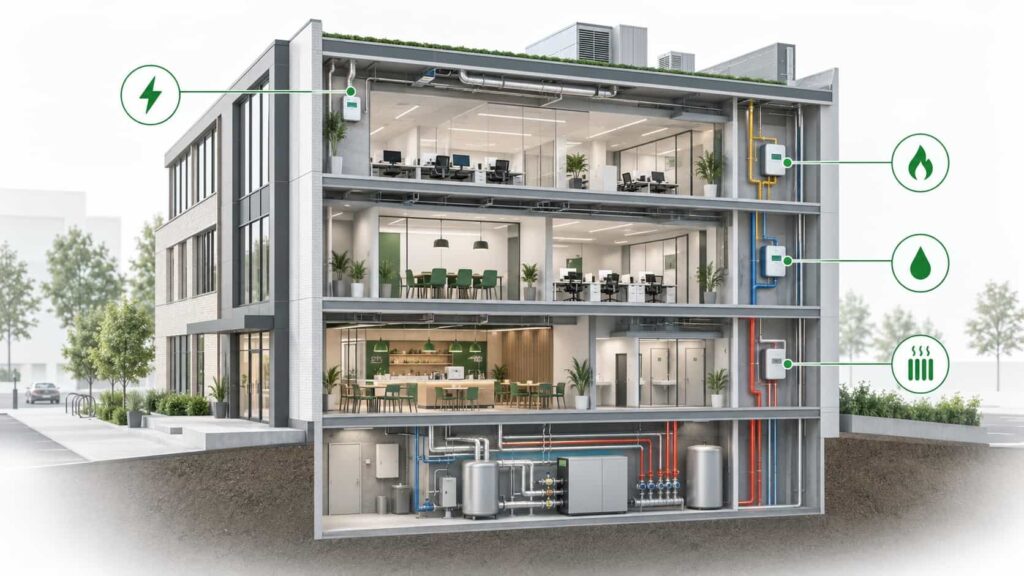
A sensible metering strategy should consider the building as a complete system.
Start with the incoming utility supplies.
Then identify major energy end uses, individual tenants, renewable generation and important building services.
Consider whether each measurement needs to be collected manually or automatically.
Then consider what happens to the information after it leaves the meter.
Who needs access to it?
How frequently should it be reviewed?
Will the readings support billing?
Does the information need to integrate with an existing energy monitoring system or BMS?
How will missing or incorrect data be identified?
The physical meter is only one part of the process.
Data collection, validation, monitoring and reporting are just as important if the information is going to be useful.
Part L sub-metering is about understanding building performance
The metering requirements in Approved Document L reflect a simple principle.
You cannot properly manage building energy consumption if you cannot see where the energy is going.
A main utility meter provides the overall total.
Sub-metering separates that total into useful parts.
Automatic meter reading makes collecting those measurements easier.
Energy monitoring turns the readings into patterns and comparisons.
Tenant metering creates visibility between different occupiers.
Renewable monitoring shows what on-site generation is actually producing.
Together, these systems make it possible to compare predicted performance with what happens once the building is occupied and operating.
For commercial buildings, that information can support compliance, but its value goes further.
A well-designed metering system can continue providing useful information throughout the life of the building, helping owners and facilities teams understand consumption, investigate waste and make better-informed energy decisions.