A traditional electricity meter answers one basic question: how much electricity has been used?
Advanced Metering Infrastructure can answer much more useful questions. When was the electricity used? Where did demand rise? Is equipment operating when the building should be empty? Are consumption patterns changing? Can readings be collected automatically? Can the information be brought together with other energy and building data?
That difference is important.
Advanced Metering Infrastructure, usually shortened to AMI, connects electricity meters with communications technology, data collection systems and software so consumption information can be collected and analysed automatically.
The simplest way to understand it is this:
A smart meter is a device. Advanced Metering Infrastructure is the wider system that allows meters, communications and energy data to work together.
For electricity users, particularly commercial buildings, industrial sites and organisations managing several properties, that can turn metering from a billing exercise into a useful source of operational information.
What is Advanced Metering Infrastructure?
Advanced Metering Infrastructure is a connected metering system used to collect, communicate, store and analyse energy consumption data.
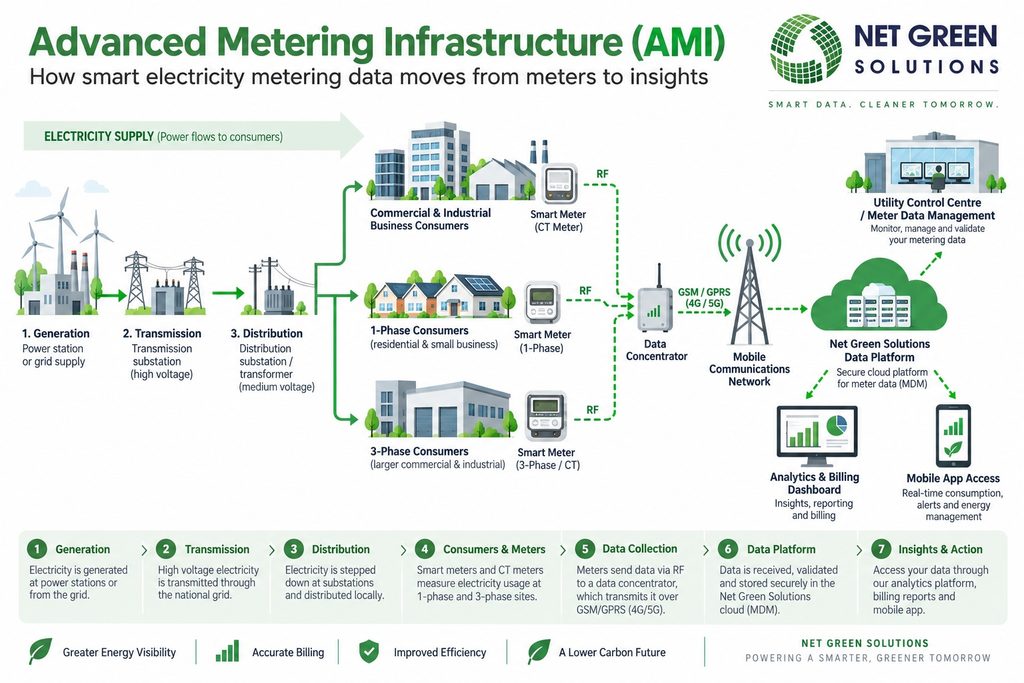
An AMI system will normally include electricity meters or smart meters, a communications network, systems for receiving meter readings, data storage and software that makes the information available for billing, monitoring, reporting or energy management.
More advanced AMI systems can support two-way communication. This means information can travel from the meter to the central system, while instructions or configuration information can also travel back towards the meter.
This is one of the main differences between Advanced Metering Infrastructure and earlier Automated Meter Reading systems.
AMI should therefore not be thought of as a particular electricity meter.
It is the infrastructure around the meter.
An easy way to picture it is:
Meter measures electricity.
Communications move the data.
A central system receives and checks it.
Software organises and analyses it.
People or connected systems use the information to make decisions.
That combination is what makes advanced metering useful.
Why is advanced metering different from a normal electricity meter?
An older electricity meter primarily records cumulative consumption.
Someone may physically read the meter, or a reading may be submitted periodically. The resulting figure is enough to calculate how many kilowatt-hours have been consumed, but it says relatively little about how the electricity was used.
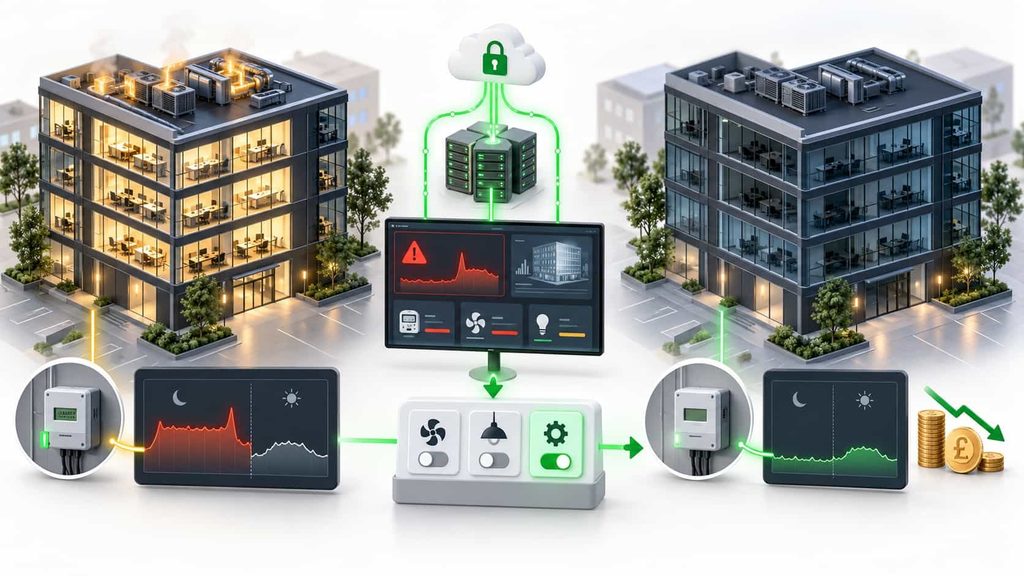
Consider two commercial buildings that each consume 20,000 kWh in a month.
Their monthly consumption may be identical, but their behaviour could be completely different.
The first building may consume most of its electricity during normal operating hours.
The second could have a high overnight base load, large morning demand peaks and equipment continuing to operate throughout weekends.
A monthly meter total does not make that difference obvious.
Interval data does.
Advanced metering allows electricity consumption to be recorded at defined intervals rather than simply providing one cumulative number. In commercial energy management, half-hourly electricity data is particularly useful because it reveals the shape of consumption across the day.
This creates a load profile.
Instead of asking only “How much electricity did we use?”, an organisation can begin asking “When are we using it, what is causing it and is that consumption necessary?”
That is where metering becomes a management tool.
How does Advanced Metering Infrastructure work?
Although AMI systems vary, the basic process follows the same principle.
Electricity is measured at the meter. Consumption readings and other available data are recorded at regular intervals.
The information is then transmitted through a communications network. Depending on the metering system, this could use cellular communications, radio networks, wired connections, power-line communications or another secure data connection.
The readings arrive at a central collection system, sometimes referred to as a head-end system. The purpose of this layer is to communicate with meters and receive the data they produce.
The information can then pass into a meter data management system, often shortened to MDMS or MDM.
This is where large quantities of meter data can be organised, validated and stored before being used by other systems.
Finally, the information becomes available through an energy monitoring platform, billing system, reporting tool, utility system or another business application.
The result is a continuous chain between physical electricity consumption and usable information.
What are the main components of an AMI system?
An Advanced Metering Infrastructure system is normally made up of several connected layers.
Advanced or smart electricity meters
The meter remains the starting point.
Modern electricity meters can record consumption at regular intervals and may also capture information such as demand, voltage, power factor, import and export readings or other electrical measurements, depending on the meter and installation.
The correct meter specification depends on what the organisation needs to measure.
A landlord allocating electricity costs between tenants may have different requirements from a manufacturer monitoring individual production lines.
Communications
Collecting detailed readings is only useful if the information can reach the system where it will be used.
AMI therefore requires a communications method between the meter and the data collection infrastructure.
The right approach depends on factors such as meter location, connectivity, building construction, the number of meters, existing infrastructure and how frequently readings need to be collected.
Head-end system
The head-end system communicates with meters or associated data collection equipment.
It acts as the receiving point for meter readings before the information moves into wider data management and business systems.
For large networks containing many meters, this part of the infrastructure helps manage communication with a large number of endpoints.
Meter data management
Raw meter readings need to be organised.
A meter data management system can store readings, check data quality, identify missing information and prepare data for other uses.
This matters because collecting more data does not automatically produce better information.
If readings are incomplete, duplicated, incorrectly mapped or associated with the wrong meter, reports and billing calculations can quickly become unreliable.
Energy monitoring and reporting
The final layer is where most building managers, facilities teams and energy managers interact with the information.
A good monitoring platform can turn thousands of individual readings into understandable consumption patterns, comparisons, reports, alarms and cost information.
This is the point at which Advanced Metering becomes practical rather than purely technical.
AMI vs AMR: what is the difference?
AMI and AMR are often used in the same conversations, but they are not exactly the same thing.
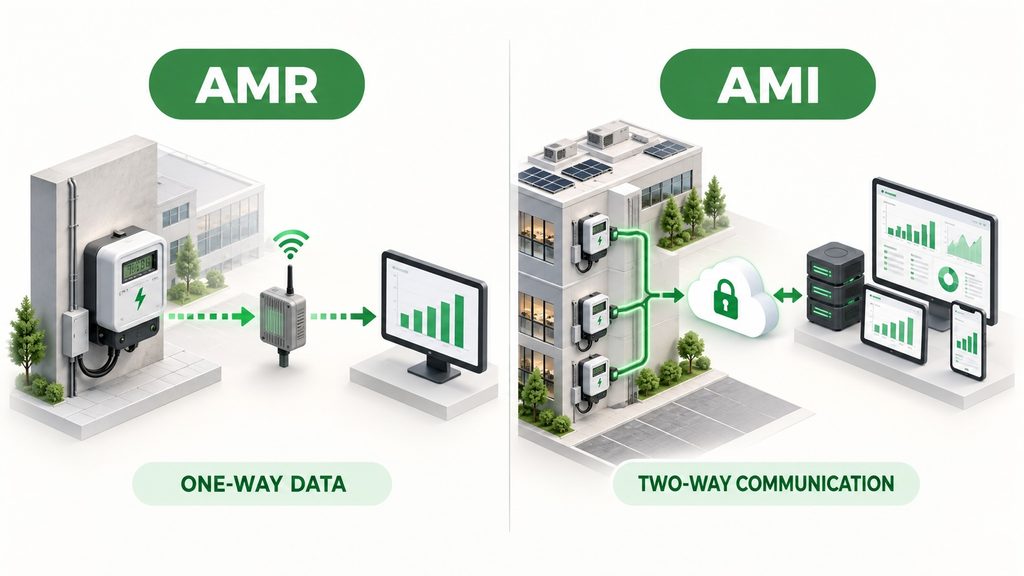
AMR stands for Automated Meter Reading or Automatic Meter Reading. It removes the need to visit a meter manually by allowing readings to be collected remotely.
The traditional distinction is that AMR is primarily a one-way process. Information travels from the meter towards the data collection system.
Advanced Metering Infrastructure goes further.
AMI is normally associated with a connected infrastructure capable of more frequent data exchange and, in full AMI implementations, two-way communication between meters and central systems.
A useful shorthand is:
AMR automates the reading.
AMI connects the wider metering system.
That does not mean AMR is outdated or unsuitable for businesses. Many organisations already have valuable AMR data available from electricity, gas, water and other utility meters.
The real problem is often not the meter itself. It is that the information is scattered across suppliers, portals and separate systems.
Bringing third-party AMR data into a central energy monitoring platform can therefore provide much of the visibility an organisation needs without replacing every existing meter.
Is AMI the same as a smart meter?
No. The terms are related, but they describe different things.
A smart meter is the physical metering device.
Advanced Metering Infrastructure includes the wider communications and data systems that allow connected meters to exchange information.
Think of a smartphone and a mobile network.
The phone is the device. The network, communications infrastructure and connected services are what allow that device to become significantly more useful.
The same principle applies to smart electricity metering.
Installing a capable meter is only one part of the job. The value comes from collecting reliable data and making it available to the people and systems that can use it.
What does “advanced meter” mean in the UK?
UK terminology can be confusing because smart meter, advanced meter, AMR and Advanced Metering Infrastructure are sometimes used as though they mean the same thing.
They do not.
In the British non-domestic energy market, organisations may encounter both advanced meters and smart meters. Larger commercial electricity supplies have also historically used half-hourly and AMR metering extensively.
For an energy manager or building operator, the practical question is usually less about the label attached to the meter and more about what information is actually available.
Can the meter provide interval data?
Can readings be collected remotely?
How frequently can the data be accessed?
Who controls access to it?
Can the data be exported?
Can it be integrated with an energy monitoring platform?
Can several meters and sites be viewed together?
Can the readings support billing or tenant cost allocation?
These questions often reveal more than the term printed on the meter specification.
Why is half-hourly electricity data so useful?
Half-hourly data breaks a day into 48 individual consumption periods.
That is dramatically more informative than a monthly total.
Imagine an office that officially operates between 8am and 6pm.
Its monthly electricity bill rises, but there has been no obvious increase in occupancy.
A total monthly reading confirms that consumption has increased. It does not explain why.
Half-hourly data may show that demand is beginning several hours before staff arrive. It may reveal a substantial overnight load. It may identify equipment running throughout weekends or show an unusually high peak every morning.
That information gives facilities teams somewhere to investigate.
Possible causes could include heating or cooling schedules, electric water heating, ventilation, refrigeration, lighting, server equipment, pumps, controls or other plant.
The meter does not always tell you which piece of equipment caused the problem.
What it does provide is evidence that a problem exists and when it occurs.
What can businesses learn from advanced electricity metering?
One of the biggest benefits of Advanced Metering is visibility.
Businesses can use interval electricity data to establish normal consumption patterns and then identify when behaviour moves outside them.
A consistent overnight load may reveal equipment that never switches off.
A sudden increase in morning demand might correspond with changes to HVAC schedules.
Unexplained weekend consumption may indicate unnecessary operation.
A gradual increase in base load may point towards equipment deterioration, operational changes or additional loads that have gone unnoticed.
For organisations occupying multiple buildings, advanced metering also makes comparison possible.
Two similar sites can be benchmarked against each other. A poorly performing building becomes easier to identify when its consumption profile is compared with similar properties.
This changes energy management from an occasional bill review into an ongoing process.

Advanced Metering and electrical sub-metering
The main electricity meter tells you what enters a site.
Electrical sub-metering helps explain where it goes.
That distinction is particularly important in commercial buildings.
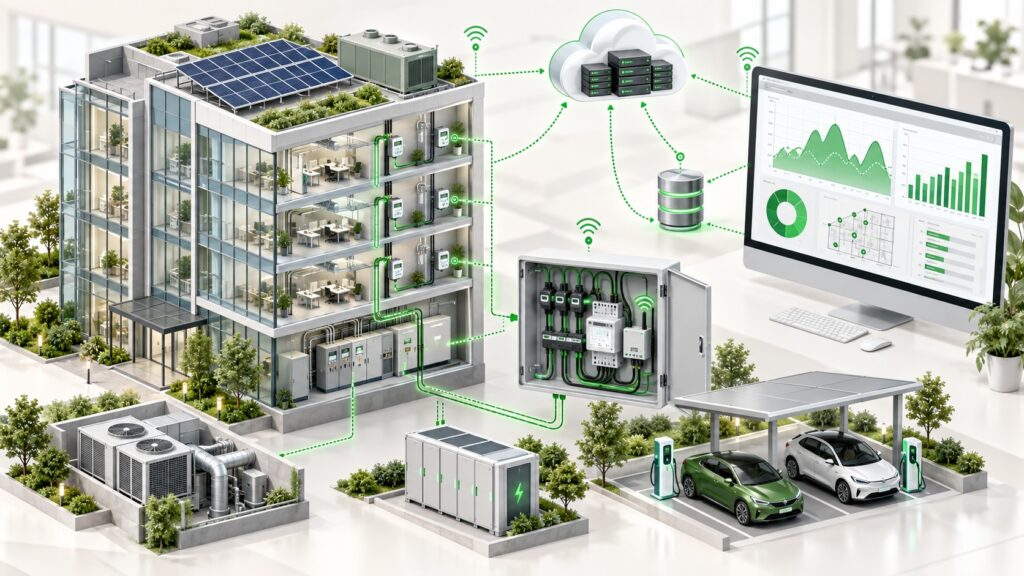
A building may have one incoming electricity supply but dozens of significant loads. These could include lighting, lifts, HVAC equipment, kitchens, EV chargers, server rooms, production equipment, individual floors or tenant areas.
If only the main meter is monitored, every one of those loads is combined into a single figure.
Sub-metering divides the electrical distribution system into useful measurement points.
For example, a property owner might meter electricity by tenant.
A facilities manager might meter HVAC separately from lighting.
A manufacturer might monitor individual production lines or energy-intensive machinery.
A university might compare electricity consumption across individual buildings.
A retailer might compare stores across an estate.
Combining advanced data collection with electrical sub-metering creates a far more detailed picture of how electricity moves through a site.
The difference between metering and energy monitoring
Metering and monitoring are closely related, but they are not the same activity.
Metering creates the measurement.
Monitoring makes repeated use of those measurements.
This distinction explains why simply installing meters does not guarantee energy savings.
A building could contain hundreds of perfectly accurate meters and still waste electricity if nobody examines the information.
The useful part begins when consumption data is reviewed, compared and acted upon.
An energy monitoring system can make this easier by presenting meter information in graphs, dashboards and reports rather than expecting users to work through thousands of individual readings.
The system can also help identify missing data, unusual consumption and changes in established patterns.
Advanced Metering therefore works best when the objective is not simply “collect more data”, but “collect data we can use”.
How Advanced Metering helps identify energy waste
Energy waste is not always dramatic.
Often it is a collection of relatively small problems that continue unnoticed.
Plant starts earlier than required.
Lighting remains on after staff leave.
A ventilation schedule still reflects an old occupancy pattern.
Electric heaters operate at the same time as cooling.
A faulty control causes equipment to cycle unnecessarily.
An EV charging load creates an unexpected demand peak.
A tenant occupies a space differently from the assumptions used when costs were calculated.
One isolated occurrence may make little difference.
Repeated every day, these behaviours can become expensive.
Advanced Metering makes repeated patterns visible.
Instead of waiting for the electricity bill to reveal that something changed, teams can examine when the change happened and how long it continued.
Advanced Metering and peak electricity demand
Energy consumption and electrical demand are related but different measurements.
Consumption describes how much electricity is used over time.
Demand describes how much electrical load is being placed on the system at a particular point or period.
A site may have reasonable total electricity consumption but still experience large demand peaks.
These peaks can be important when considering electrical capacity, operating patterns, tariffs and the introduction of new loads.
For example, installing several EV chargers may not dramatically change a site’s monthly consumption at first, but simultaneous charging can materially change the electrical demand profile.
The same can happen when heating, cooling, process machinery or other large loads start together.
Detailed metering data helps organisations understand these patterns before making decisions about infrastructure or operating schedules.
Advanced Metering and electric vehicle charging
EV charging is creating new electricity loads in offices, industrial facilities, retail sites, residential developments and public buildings.
The question is not simply how many kilowatt-hours the chargers consume.
Organisations also need to understand when vehicles charge, how charging overlaps with existing building demand and whether electrical capacity is being used efficiently.
Metering the EV charging infrastructure separately can provide that visibility.
When charging information is considered alongside the building’s wider load profile, operators can make better decisions about charging schedules, load management and future expansion.
This becomes increasingly valuable as the number of chargers grows.
Advanced Metering and Building Management Systems
A Building Management System and an energy monitoring system answer different questions.
A BMS controls and monitors building services such as heating, ventilation, cooling, lighting and plant.
Metering shows the energy those systems consume.
Bringing the two datasets together can provide valuable context.
Suppose electricity consumption for a ventilation system increases by 20 per cent.
Metering identifies the increase.
BMS data may show that operating hours were extended, a control set point changed or a piece of equipment has been running continuously.
Neither dataset necessarily gives the complete answer on its own.
Together, they can make diagnosis much easier.
This is one reason centralising metering, AMR and BMS data can be useful for complex buildings.

Why data quality matters
The quality of an Advanced Metering system depends on more than meter accuracy.
A perfectly accurate meter is of limited value if its data regularly goes missing.
Good metering data management should therefore consider completeness, consistency and context.
A monitoring platform needs to know which meter belongs to which building, tenant, circuit or utility. Changes to meters should be documented correctly. Missing readings should be identified. Unusual values should be investigated rather than silently included in reports.
This becomes increasingly important as the number of meters grows.
Ten meters can often be checked manually.
Ten thousand interval readings across hundreds of meters and multiple sites require a more systematic approach.
Data quality is what allows organisations to trust the reports produced from the system.
Advanced Metering for tenant billing and cost allocation
Multi-occupied buildings are one of the clearest applications for electrical sub-metering.
If several tenants share one incoming supply, landlords and managing agents need a sensible method of allocating electricity costs.
Estimated consumption can create disputes because the calculation may not reflect how individual spaces are actually being used.
Metered consumption provides a stronger basis for allocation.
Detailed interval data can also help investigate unusual bills or changes in tenant behaviour.
The same principle can be applied internally.
A large organisation might allocate energy costs between departments, buildings, cost centres or production processes.
This makes energy expenditure visible to the people responsible for it rather than leaving the entire cost within a single central utility budget.
Advanced Metering across multiple sites
Energy management becomes more difficult when an organisation operates a portfolio of properties.
Each site may have different suppliers, meter types, data formats and monitoring systems.
One building might provide half-hourly electricity data through an AMR provider.
Another may have smart meters.
A third could contain extensive sub-metering.
A fourth might have valuable information sitting inside its BMS.
The challenge is no longer simply collecting readings.
It is creating a consistent view.
Centralised data management can bring those different sources together so sites can be compared using the same reporting structure.
This makes portfolio benchmarking much more useful.
Instead of looking at each building in isolation, organisations can identify high-consuming sites, unusual load profiles and opportunities that deserve further investigation.
Can AMI reduce electricity costs?
Advanced Metering does not reduce electricity consumption by itself.
It provides the information needed to find opportunities.
That difference is important.
Installing a new meter will not automatically lower a bill. Savings occur when the information leads to a change in operation, maintenance, controls, equipment, procurement or behaviour.
For example, data might reveal unnecessary overnight consumption.
A facilities team investigates and discovers that ventilation plant is operating for several additional hours every night.
The controls are corrected.
Electricity consumption falls.
The meter did not save the energy. It made the waste visible.
That is the practical value of good monitoring.
How does Advanced Metering support carbon reporting?
Electricity consumption data is one of the foundations of energy and carbon reporting.
Reliable metering helps organisations understand how consumption changes over time and whether energy reduction projects are producing the expected result.
This is particularly valuable when organisations have several sites, departments or operating activities.
Rather than relying entirely on annual totals, interval and sub-meter data can provide evidence of where reductions occurred.
It can also help explain why emissions rise despite improvement projects.
For example, an organisation may install LED lighting and reduce lighting consumption while simultaneously increasing EV charging or production output.
More detailed metering makes those changes easier to separate and understand.
Does Advanced Metering Infrastructure support renewable energy?
Advanced electricity metering can also help organisations understand on-site generation.
Buildings with solar PV need to know more than how much electricity they import from the grid.
Depending on the installation, organisations may want visibility of generation, building consumption, exported electricity and the relationship between the three.
Interval data can show whether electricity is being consumed while solar generation is available or exported because demand is low at that time.
As buildings add solar PV, battery storage, heat pumps and EV charging, understanding the timing of electricity flows becomes increasingly important.
The electrical system is no longer simply a building consuming power from the grid.
It may consume, generate, store and shift electricity at different times.
Metering provides the evidence needed to understand that behaviour.
What should you consider before installing an advanced metering system?
The best metering system is not necessarily the one with the largest number of meters.
It is the one that answers useful questions.
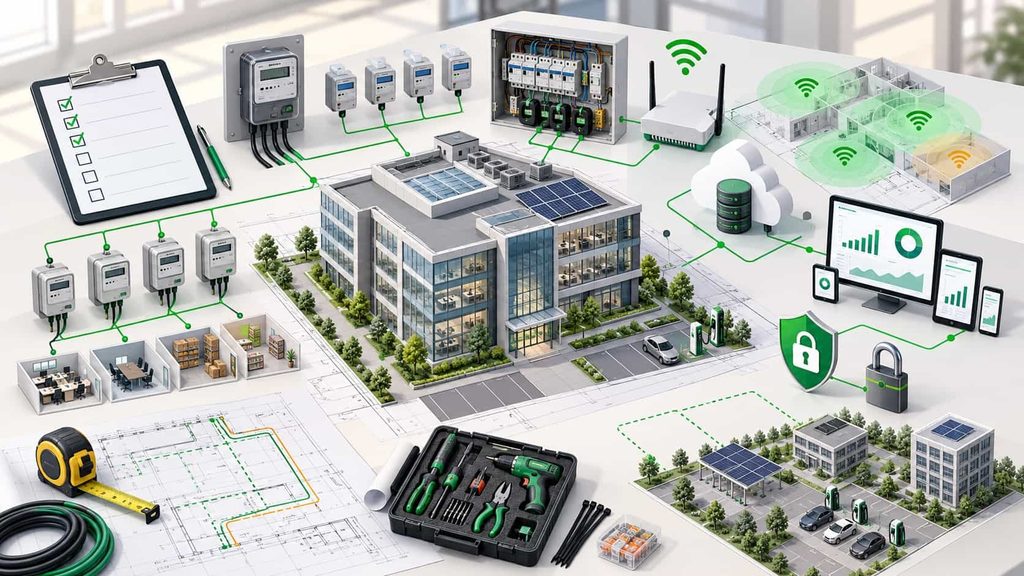
Before expanding a metering system, an organisation should define what it wants to understand.
Questions worth considering include:
- Which electricity costs or consumption patterns are currently unclear?
- Do we need site-level, tenant-level, floor-level, circuit-level or equipment-level information?
- What meters already exist?
- Is usable AMR or smart meter data already available?
- How frequently do we need readings?
- Where will the data be stored?
- Can existing meter and BMS data be integrated?
- Who will review the information?
- Do we need alarms for abnormal consumption or missing data?
- Will the readings be used for tenant billing or cost allocation?
- How will new meters fit into the existing electrical infrastructure?
- Can the system expand as more sites, EV chargers or other electrical loads are added?
Starting with these questions helps avoid a common mistake: collecting huge quantities of data without deciding how the information will be used.
Does every business need full AMI?
Not necessarily.
Advanced Metering Infrastructure can describe a very sophisticated utility-scale system with millions of connected meters, two-way communications and extensive central control.
That is not what every commercial organisation needs.
A business may already have the essential building blocks.
It might have an AMR electricity meter, several electrical sub-meters and access to half-hourly consumption data. Bringing those sources into a good energy monitoring platform may provide the required visibility without replacing the entire metering estate.
The right level of infrastructure depends on the objective.
If the aim is accurate tenant billing, a carefully designed sub-metering system may be enough.
If the aim is portfolio-wide energy management, centralised data collection becomes more important.
If the organisation needs detailed operational analysis, integration with BMS and equipment data may add further value.
The technology should follow the question, not the other way around.
Advanced Metering is really about making electricity visible
Electricity is difficult to manage when it is represented by a single number on a monthly bill.
Advanced Metering changes that.
It gives electricity a time dimension.
Sub-metering can give it a location.
BMS integration can give it operational context.
Cost data can give it financial meaning.
Reporting can connect it with energy and carbon targets.
That is why the most useful Advanced Metering systems are not simply collections of smart meters.
They create a chain from measurement to understanding.
For a commercial organisation, that chain might start at a distribution board and finish with a facilities manager discovering that a piece of plant is running all night.
For a property manager, it might start with tenant meters and finish with accurate cost allocation.
For a multi-site business, it might reveal that one apparently similar building is using substantially more electricity than the rest.
The purpose is not to generate more data.
It is to make energy use easier to explain.
Frequently asked questions about Advanced Metering Infrastructure
What does AMI stand for in electricity?
AMI stands for Advanced Metering Infrastructure. It describes the meters, communications technology, data systems and software used to collect and manage detailed electricity consumption information.
What is the difference between AMI and AMR?
AMR primarily automates the collection of meter readings. AMI describes a wider connected metering infrastructure and is commonly associated with more frequent data collection and two-way communication between meters and central systems.
Is a smart meter an AMI meter?
A smart meter can form part of an AMI system, but the meter itself is not the entire infrastructure. AMI also includes communications, data collection, data management and the systems used to analyse or act on the information.
What is Advanced Metering used for?
Advanced Metering can support accurate billing, energy monitoring, load profiling, tenant cost allocation, demand analysis, abnormal consumption detection, multi-site reporting and energy efficiency programmes.
What is half-hourly electricity data?
Half-hourly data records electricity consumption in 30-minute periods. A complete day therefore contains 48 consumption intervals, giving a much clearer picture of when electricity is being used than a monthly meter reading.
What is a load profile?
A load profile shows how electricity demand or consumption changes over time. It can reveal operating hours, base loads, demand peaks, overnight consumption and other patterns that are difficult to identify from monthly bills.
What is electrical sub-metering?
Electrical sub-metering measures electricity at additional points beyond the main incoming supply. Sub-meters can monitor tenants, floors, distribution boards, equipment, EV chargers, plant or other significant electrical loads.
Can existing AMR meters be used with an energy monitoring platform?
Often, yes. Existing third-party AMR data may be capable of being integrated into a central monitoring platform, depending on the provider, available data feeds and access arrangements.
Can Advanced Metering identify faulty equipment?
Metering cannot diagnose every equipment fault directly, but changes in consumption patterns can provide an early indication that something is operating differently. Facilities teams can then investigate the equipment or systems associated with the change.
Can AMI monitor gas and water as well as electricity?
Yes. Advanced and automated metering concepts are also used for gas, water, heat and other utilities. For commercial energy management, bringing several utility datasets together can provide a more complete picture of building performance.
Making better use of electricity data
Advanced Metering Infrastructure is best understood as the connection between measurement, communication and usable energy information.
For UK businesses, the practical value is not the acronym AMI itself. It is having reliable access to electricity data that explains when energy is being used, where it is going and what has changed.
Smart meters, AMR, electrical sub-metering, half-hourly data, energy monitoring and BMS information can all form parts of that picture.
The more clearly an organisation can see its consumption, the easier it becomes to investigate waste, allocate costs, compare buildings, manage new electrical loads and measure whether energy improvements are actually working.
If your organisation is reviewing electrical sub-metering, AMR data, smart meter monitoring or centralised energy data, Net Green Solutions can help assess the information already available and identify where additional metering or monitoring could provide useful insight.