A building can contain dozens or even hundreds of meters and still provide poor energy information.
Meters may be incorrectly located, badly labelled, difficult to access, unable to communicate with the monitoring system or measuring loads that nobody actually needs to understand.
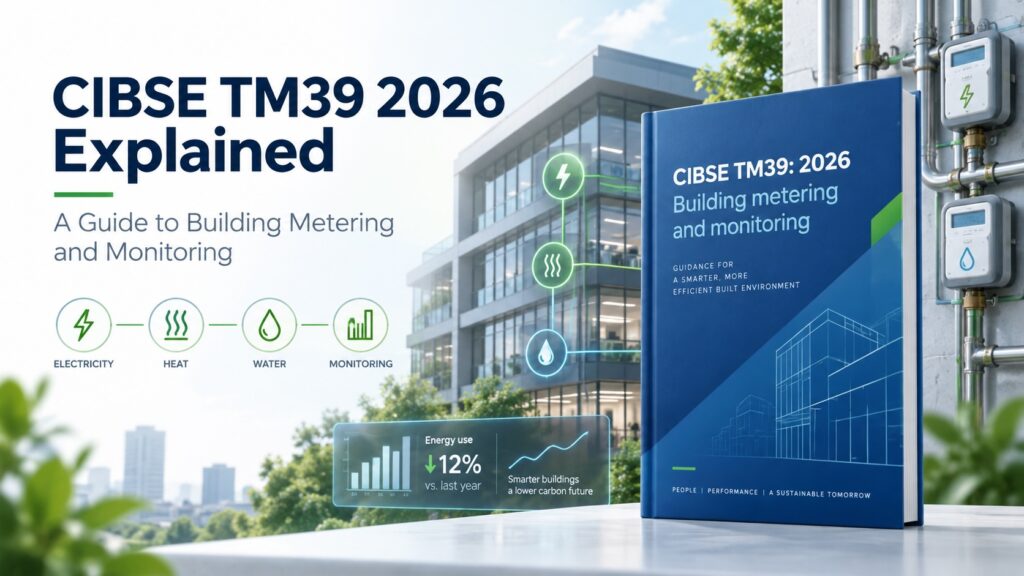
CIBSE TM39: Building Metering and Monitoring addresses this problem by treating metering as a complete process rather than simply a collection of devices.
The 2026 edition is a major revision of the previous guidance. It reflects how much building energy management has changed since the earlier edition was published in 2009.
Modern buildings now contain smart meters, renewable generation, heat pumps, EV charging, automated controls, Building Management Systems, data platforms and increasingly complex landlord and tenant arrangements.
TM39 2026 provides a framework for deciding what should be measured, how meters should be selected and installed, how readings should be collected and how the resulting data should be checked and used.
What is CIBSE TM39?
TM39 is technical guidance published by the Chartered Institution of Building Services Engineers, commonly known as CIBSE.
The 2026 edition is titled Building Metering and Monitoring.
It provides good-practice guidance for designing, specifying, installing, commissioning and operating metering systems in non-domestic buildings.
It is relevant to both new and existing buildings and is aimed at people including:
- Building owners
- Facilities managers
- Energy managers
- Landlords
- Managing agents
- Building services engineers
- Consultants
- Designers
- Contractors
- Tenants
- Estates teams
TM39 is not simply an electricity-metering guide.
The latest edition considers electricity, thermal energy, water, steam and other aspects of building metering, as well as the communication and data systems needed to make those measurements useful.
What changed in CIBSE TM39 2026?
Building technology has changed substantially since the previous edition of TM39.
The 2026 guidance has therefore expanded well beyond traditional electricity and gas metering.
There is now greater attention on:
- Metering strategy
- Meter selection and sizing
- Meter positioning
- Meter communications
- Automatic meter reading
- Data collection
- Data visualisation
- Data validation
- Meter commissioning
- Tenant billing
- Building energy analytics
- Cybersecurity
- Meter documentation
- Renewable energy systems
- Thermal energy
- Water
- Steam
- Heat pumps
- Energy storage
The central message is that a meter should not be installed simply because a drawing says one is required.
There needs to be a clear reason for collecting the data.
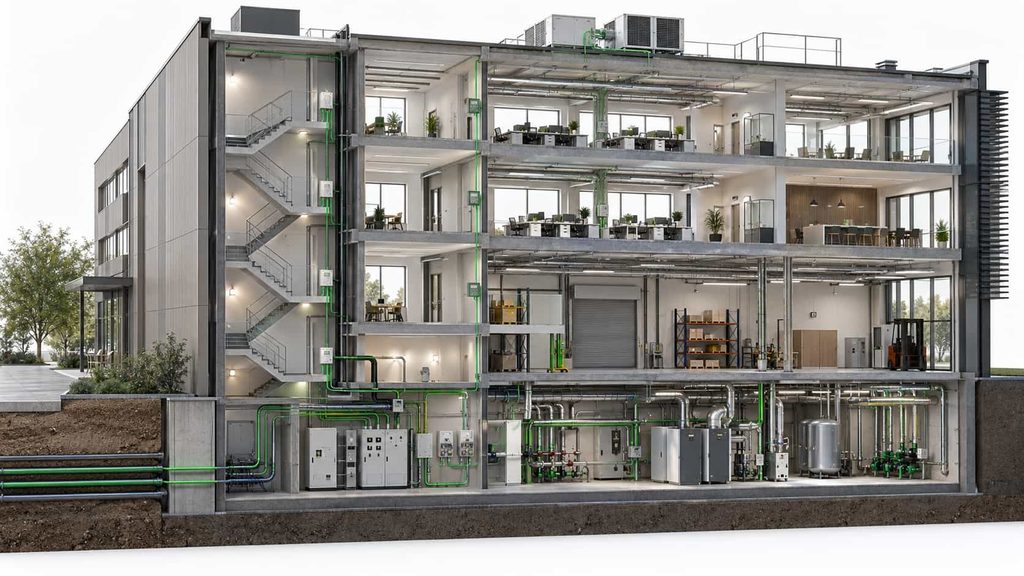
Start with a metering strategy
A useful metering system begins with questions rather than equipment.
What does the building owner need to know?
Which areas consume the most energy?
Does the landlord need to separate tenant and communal consumption?
Does a facilities team need to monitor heating, ventilation and cooling independently?
Does renewable generation need to be measured?
Does the organisation need to compare several buildings?
Will meter readings be used for billing?
How frequently is the information required?
TM39 places considerable importance on developing a metering strategy before deciding which meters to install.
This helps avoid a common problem in commercial buildings: collecting large quantities of data that nobody understands or uses.
Understanding the metering boundary
A metering strategy needs a clearly defined boundary.
For a small office, the boundary may simply be the entire building.
For a large university, hospital or commercial estate, the situation can be more complicated.
The organisation might need to consider:
- Incoming utility supplies
- Separate buildings
- Tenant areas
- Landlord areas
- Individual floors
- Plant rooms
- Heating and cooling systems
- Renewable generation
- EV charging
- Process equipment
- External facilities
Once the boundary is understood, energy and water flows can be mapped across it.
This makes it easier to decide which points should be metered.
What should be sub-metered?
There is no single sub-metering layout that works for every building.
An office has a very different energy profile from a hotel, university, factory or shopping centre.
In a typical commercial building, useful electrical sub-metering might include:
- Lighting
- Heating
- Cooling
- Ventilation
- Server rooms
- Commercial kitchens
- Lifts
- Tenant areas
- EV charging
- Large plant
- Process equipment
- Solar PV generation
- Other significant electrical loads
The same principle applies to other utilities.
Water consumption might be divided between tenant areas, communal use, kitchens and process requirements.
Heat meters can help identify the thermal energy delivered to individual areas or systems.
Steam metering may be required in industrial, healthcare or other specialised facilities.
The objective is not to meter absolutely everything.
The objective is to obtain enough useful information to understand the building.
Selecting the right meter
Meter selection is more important than simply choosing a device capable of producing a reading.
Different applications require different measurement technologies.
For electrical installations, the decision may include whether direct-connected or current-transformer metering is appropriate.
Thermal energy measurement may require consideration of flow rate, temperature differences and sensor positioning.
Water and steam present their own technical requirements.
Accuracy is also important.
A meter used simply to monitor an internal energy trend may have different requirements from a meter whose readings are used to allocate costs between tenants.
The measurement range matters too.
A meter that is technically capable of measuring a system may still perform poorly if it is badly matched to the actual load.
Good meter selection considers the intended use of the data before specifying the hardware.
Meter placement matters
Where a meter is installed affects what the reading means.
Consider an electrical sub-meter intended to measure an entire floor.
If additional circuits serving another area are connected downstream of the same measurement point, the meter will not represent the floor accurately.
The problem may remain unnoticed for years.
The same issue can occur with thermal, water and other metering.
Good design should establish exactly what passes through the measurement point.
This should then be documented so future facilities teams can understand what the meter represents.
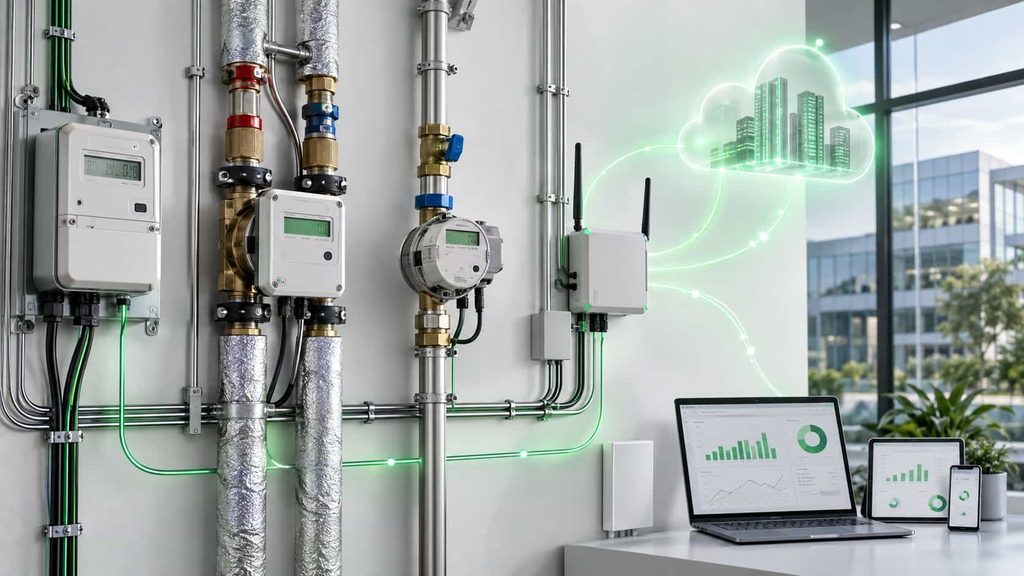
Meter communications are now a major part of building metering
Modern energy monitoring increasingly depends on automatic data collection.
A meter can be accurate but still provide little value if readings cannot be collected reliably.
Meter communications may involve technologies such as:
- Wired networks
- Wireless communications
- Mobile networks
- Building networks
- Gateways
- Data loggers
- AMR equipment
- Building Management Systems
- Cloud-based platforms
The right communication method depends on the building.
Plant rooms, basements, risers and large estates can all create communication challenges.
It is therefore important to consider meter communications during design rather than treating them as an afterthought once meters have already been installed.
Automatic Meter Reading
Manual readings still have a place, particularly for small numbers of meters.
However, they become difficult to manage as the metering estate grows.
A building with 100 meters could require substantial staff time simply to collect readings.
Automatic Meter Reading can collect meter data remotely.
This reduces reliance on physical site visits and allows readings to be collected more consistently.
Automatic collection also makes interval data much more practical.
Instead of one monthly value, a monitoring system can potentially receive daily, hourly or half-hourly information depending on the meter and application.
That provides far greater visibility of how a building operates.
Why meter documentation matters
One of the less glamorous parts of metering is also one of the most important.
Documentation.
Facilities teams frequently inherit buildings containing meters that are poorly labelled or no longer match the documentation supplied when the building was constructed.
A label such as:
- DB3-M2
may mean very little to somebody managing the property ten years later.
Good documentation should make it possible to understand:
- Where the meter is located
- What it measures
- Which system it belongs to
- What units it records
- How it communicates
- Where its data is stored
- Whether it is used for billing
- How it relates to other meters
TM39 places importance on meter naming conventions, meter schedules, drawings and commissioning records.
Maintaining this information creates a useful record that can follow the building through design, installation and operation.
Commissioning meters properly
Installing a meter does not prove that it works correctly.
Meters need to be commissioned.
For an electrical meter, commissioning may involve checking that the correct circuits are being measured and that current transformers and phases have been installed correctly.
A wiring or configuration error can produce data that looks believable while still being wrong.
That is particularly dangerous because incorrect data may continue unnoticed.
Commissioning should therefore confirm not only that the meter produces a reading, but that the reading makes sense.
Where possible, meter readings should also be reconciled against other known measurements.
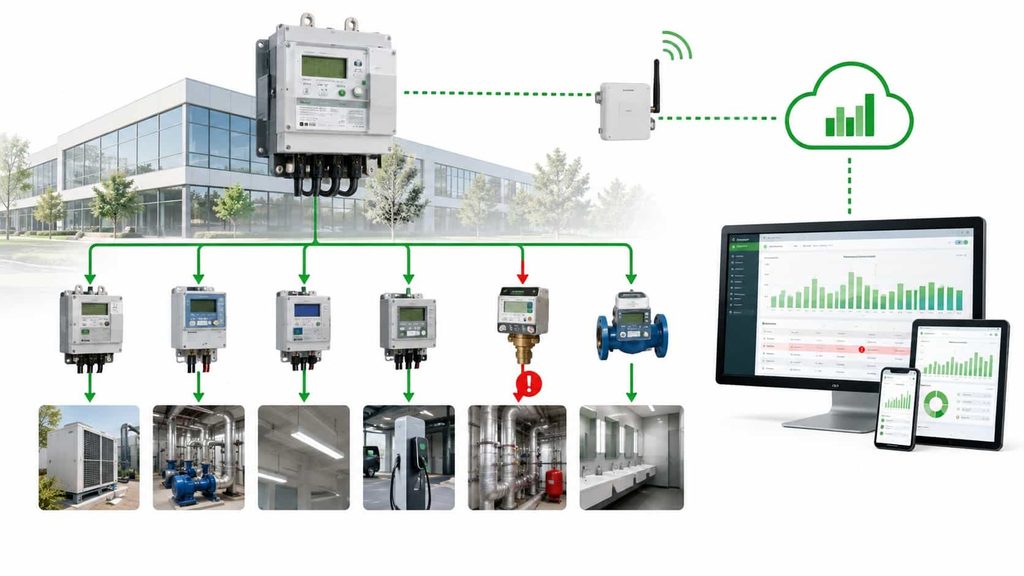
Why data validation matters
Modern buildings can generate enormous quantities of energy data.
More data does not automatically mean better information.
Readings can be:
- Missing
- Duplicated
- Incorrectly timestamped
- Associated with the wrong meter
- Recorded using incorrect units
- Affected by communication failures
- Distorted by meter faults
A monitoring system should therefore include some form of data validation.
One useful approach is reconciliation.
If a main electricity meter measures the total consumption entering a building, the major electrical sub-meters below it should broadly explain that total.
They may not match exactly because some unmetered loads and measurement differences can remain, but large unexplained gaps deserve investigation.
This simple check can reveal incorrectly configured meters, missing data or parts of the building that have not been accounted for.
Turning readings into useful information
The real purpose of building metering is not to produce more numbers.
It is to improve understanding.
A useful monitoring platform can transform meter readings into:
- Daily consumption profiles
- Half-hourly load profiles
- Month-on-month comparisons
- Building benchmarks
- Tenant consumption
- Energy intensity metrics
- Cost information
- Baseload analysis
- Peak demand
- Renewable generation
- Alerts
- Carbon reporting
A facilities manager should be able to move from a building-level overview to an individual meter without needing to analyse thousands of spreadsheet rows.
Good visualisation helps turn meter data into something people can actually use.
Metering can reveal out-of-hours consumption
One of the simplest uses of detailed energy data is identifying what happens when a building should be quiet.
Consider an office that closes at 6pm.
Its half-hourly electricity profile might show consumption falling during the evening but remaining unexpectedly high throughout the night.
That does not immediately identify the cause.
It does, however, provide a clear reason to investigate.
Possible sources could include:
- Ventilation
- Cooling
- Heating
- Lighting
- Kitchen equipment
- Electric water heating
- Pumps
- IT systems
- Equipment left operating
A meter cannot fix these problems.
It can make them visible.
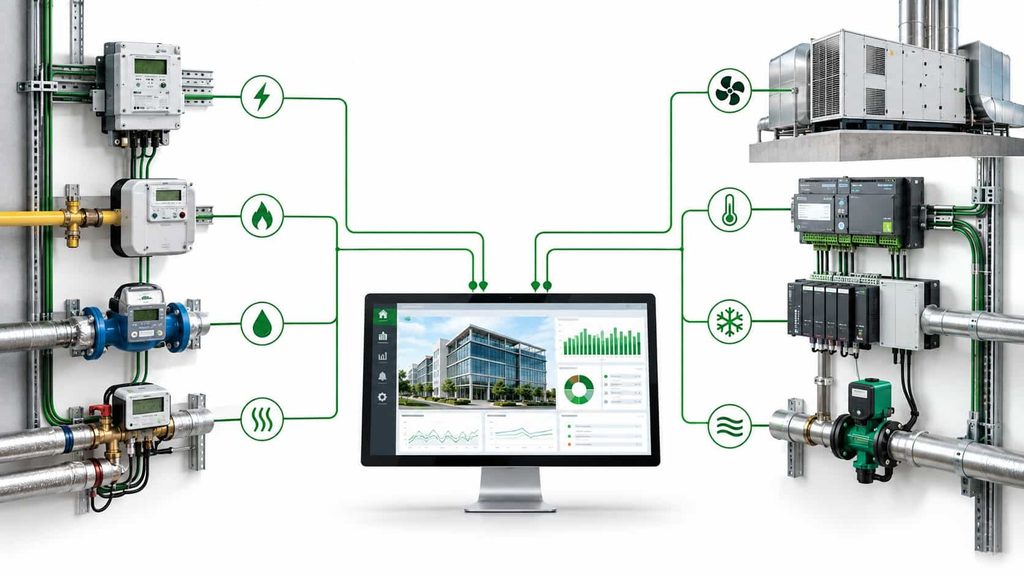
Building metering and BMS data
Metering and Building Management Systems provide different types of information.
Meters measure energy.
A BMS typically shows what building services are doing.
Combining the two can be particularly useful.
For example, a meter may show electricity demand increasing sharply at 4.30am every weekday.
BMS data might show that the air-handling system also starts at 4.30am.
The facilities manager can then determine whether that start time is necessary.
Energy data provides evidence of the consumption.
Building controls provide operational context.
TM39 and tenant billing
Metering becomes particularly important in multi-tenanted buildings.
Landlords may need to separate:
- Tenant consumption
- Landlord consumption
- Communal areas
- Shared plant
- Heating or cooling supplied to individual occupiers
Metering used for tenant billing needs particular attention because the readings have a financial consequence.
The meter needs to measure the correct area, the readings need to be reliable and there must be a clear relationship between consumption and the costs being allocated.
Good documentation is particularly important when tenants change or a property is reconfigured.
Cybersecurity and connected metering
Building meters increasingly communicate with remote platforms.
This creates benefits, but it also means metering needs to be considered as part of the building’s wider digital infrastructure.
A connected metering system should not be designed in isolation from IT and cybersecurity requirements.
Access permissions, communications architecture, remote connections and the systems receiving meter data should all be considered.
This becomes more important as energy systems, BMS platforms and other operational technologies become increasingly connected.
How does TM39 relate to Part L?
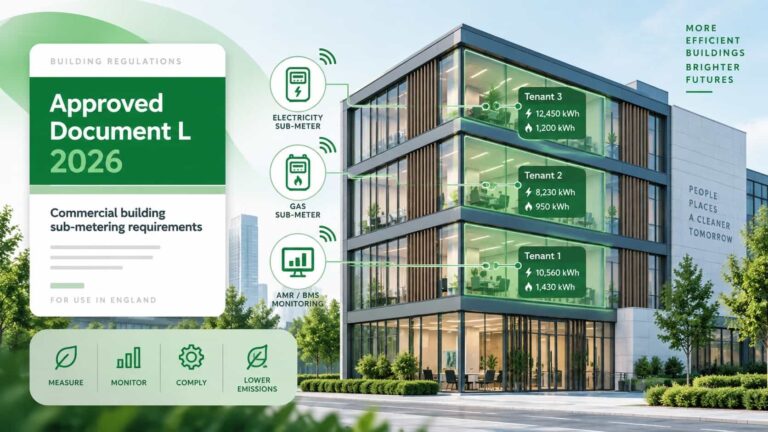
Approved Document L provides regulatory guidance around energy metering and sub-metering in buildings other than dwellings.
TM39 provides much more detailed technical guidance for developing and operating a useful metering system.
The two therefore complement each other.
Part L may establish what level of energy measurement is expected.
TM39 helps explain how a good metering strategy can be designed, documented, commissioned and used.
This distinction is important.
Compliance should not be the end goal of a metering system.
A well-designed system should continue delivering useful information long after the building has been completed.
TM39 is relevant to existing buildings too
A building does not need to be new to benefit from a metering strategy.
Older commercial buildings frequently contain a mixture of:
- Legacy meters
- New sub-meters
- Supplier meters
- AMR equipment
- Tenant meters
- BMS data
- Meters added during refurbishments
- Meters that are no longer used
In these situations, the first step should often be a metering survey.
Establish what is already installed.
Identify what each meter measures.
Check whether the meter works.
Determine whether readings can be collected.
Understand where the data currently goes.
Only then should additional meters be considered.
There is little benefit in installing another meter if an existing device already provides the required information.
Common building metering mistakes
Several problems appear repeatedly in commercial metering systems.
Installing meters without defining what the data will be used for.
Failing to document what each meter measures.
Choosing a meter poorly suited to the expected load.
Installing the meter in the wrong location.
Not commissioning the meter properly.
Ignoring meter communications until the end of a project.
Collecting data without validating it.
Creating dashboards nobody uses.
Failing to update records when a building changes.
Replacing equipment without considering existing meters.
Treating the meter installation as finished once construction is complete.
Avoiding these problems can be more valuable than simply increasing the number of meters.
From metering to building performance
CIBSE TM39 2026 reflects an important change in the way commercial buildings are managed.
Metering is no longer simply about recording utility consumption.
A modern metering system can help explain how a building behaves.
It can show when energy is used, where it is consumed and how different areas compare.
It can support tenant billing, building benchmarking, energy reporting and investigations into unexpected consumption.
But those benefits depend on the quality of the entire system.
The right meter must measure the right load.
The data needs to reach the monitoring system.
The readings need to be checked.
The meter needs to be documented.
And somebody needs to use the information.
That is what turns a meter from a box on the wall into a useful building-management tool.