
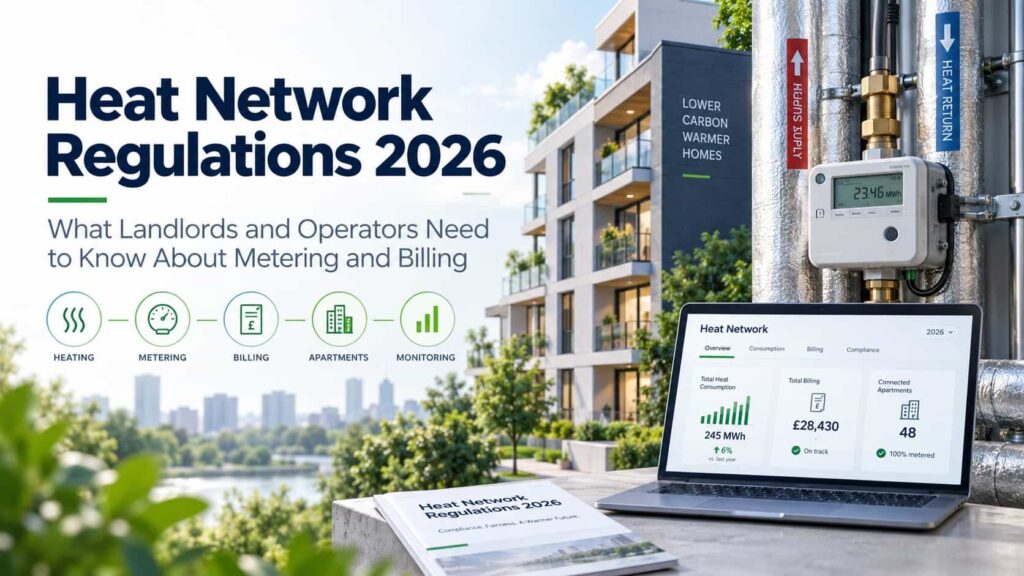
Heat networks entered a new regulatory era in Great Britain in 2026.
For landlords, managing agents, housing providers, developers and organisations responsible for communal or district heating, this means heat networks can no longer be treated simply as another building service.
Ofgem now regulates the sector in Great Britain, with requirements covering areas including registration, billing, pricing, customer service, complaints, data and consumer protection.
Metering remains an important part of that picture.
Where heat is measured, the quality of the meter data affects billing, cost allocation and the ability to understand how the network is performing.
For anyone responsible for a heat network, it is therefore important to understand both the regulatory changes and the practical role of heat metering.

What is a heat network?
A heat network supplies heating, cooling or hot water from a central source to more than one property or building.
Rather than every property having its own boiler or heat-generation system, energy is generated centrally and distributed through a network of pipes.
There are two common forms.
A communal heat network typically serves several properties within one building.
A district heat network can supply multiple buildings from a central energy centre.
Heat networks can serve:
- Blocks of flats
- Mixed-use developments
- University campuses
- Hospitals
- Commercial estates
- Public buildings
- Housing developments
- Industrial sites
The central heat source can use different technologies and fuels.
The regulatory issue is not simply how the heat is produced, but how heating, cooling or hot water is supplied to customers through the network.
What changed in 2026?
Heat networks in Great Britain were historically much less regulated than gas and electricity supply.
That changed in January 2026.
Ofgem became the regulator for heat networks in England, Scotland and Wales under the new regulatory framework.
The aim is to provide heat-network customers with protections around areas such as:
- Billing
- Pricing
- Customer service
- Complaints
- Reliability
- Transparency
- Vulnerable consumers
Heat-network operators and suppliers now need to understand whether their activities fall within the regulatory framework and which requirements apply to them.
Existing relevant heat networks also need to complete the Ofgem registration process within the required timeframe.
Who is a heat network operator?
The operator is generally the organisation responsible for the physical network.
That can include ownership or significant control of assets such as:
- Pipework
- Heat exchangers
- Substations
- Energy centres
- Other heat-network infrastructure
The operator is responsible for the way the network is operated and maintained.
Who is a heat network supplier?
The supplier provides heating, cooling or hot water to the customer.
The supplier is typically the organisation that has the supply relationship with the consumer and receives payment for the heat supplied.
The operator and supplier can be separate organisations.
However, the same organisation can also perform both roles.
This is particularly relevant to landlords.
A property owner operating a communal heating system and charging tenants or residents for heat may have responsibilities that extend beyond simply maintaining the plant.
Understanding which organisation performs each regulated role is therefore an important starting point.
Why landlords need to pay attention
A landlord may think of a central heating system as part of the property’s mechanical services.
From the consumer’s perspective, however, that system is providing energy.
Where occupants are charged for heating, cooling or hot water supplied through a heat network, issues such as metering, billing and cost allocation become particularly important.
The new regulatory framework means landlords responsible for relevant networks need to consider their position as a possible operator, supplier or both.
This applies particularly to:
- Residential blocks
- Mixed-use developments
- Student accommodation
- Commercial properties with central heat systems
- Large estates
- Properties where heat costs are recovered from occupiers
The exact obligations depend on the network and the consumers it serves, so organisations should establish their regulatory position rather than assuming the rules do not apply.
Heat network registration
One of the major changes is the requirement for relevant heat networks to be registered with Ofgem.
Registration provides information about the organisations responsible for the network and the way it operates.
Operators and suppliers need to identify their respective roles and provide the required information through Ofgem’s regulatory service.
Registration is not the same thing as compliance.
Registering the network does not remove the ongoing responsibility to follow the authorisation conditions that apply to the organisation.
For property owners managing several developments, identifying every heat network and the responsible legal entities should therefore be treated as a structured exercise rather than a last-minute administrative task.
How does heat metering fit into the regulations?
Heat metering has been part of the regulatory landscape for many years.
The 2026 changes altered parts of the previous Heat Network (Metering and Billing) Regulations in Great Britain as responsibilities moved into the new regulatory framework.
The result is not that heat metering has stopped mattering.
Quite the opposite.
Accurate meter data is fundamental where bills are based on consumption.
Existing networks with meters need to ensure that those meters continue to operate properly.
For networks where meter installation requirements apply, the appropriate metering arrangements still need to be considered.
The direction of travel is clear: reliable measurement and transparent information are central to fair heat-network operation.
What does a heat meter measure?
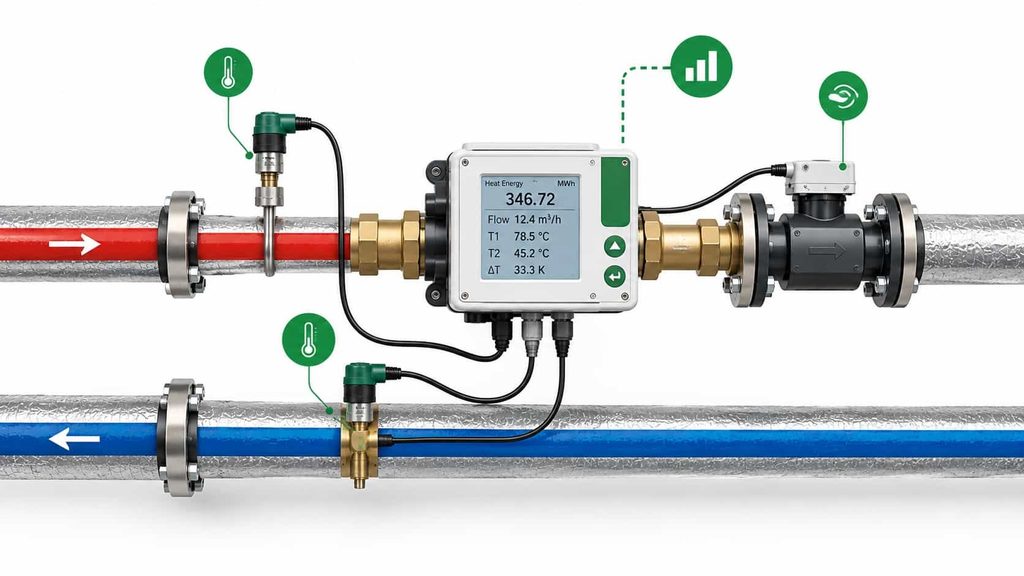
A heat meter measures thermal energy rather than simply measuring the amount of water flowing through a pipe.
To calculate heat consumption, the system typically considers:
- The volume or flow rate of the heat-transfer fluid
- The temperature entering the property or system
- The temperature returning from it
- The difference between those temperatures
Using these measurements, the meter can calculate the quantity of thermal energy delivered.
This is usually expressed in units such as kWh.
That gives the operator a measurable basis for understanding how much heat has been supplied to a building, tenant or individual property.
Why accurate heat metering matters for billing
Where consumers are billed using meter readings, inaccurate data can create obvious problems.
A meter may fail.
Communications may be interrupted.
A device may be incorrectly configured.
Readings may stop reaching the billing system.
A meter may be associated with the wrong property.
Any of these problems can affect the information used to calculate bills.
The 2026 regulatory framework places considerable importance on accurate and transparent billing.
Where supply meters are installed and the relevant rules apply, bills should generally reflect actual consumption rather than relying indefinitely on estimated usage.
This makes meter maintenance and data quality part of the billing process rather than purely an engineering issue.
Actual readings and estimated bills
There will be situations where an actual meter reading cannot be obtained.
For example, a communications problem may prevent a smart meter reading from being collected.
The regulatory framework allows for estimates in certain circumstances.
However, an organisation should not use estimated readings as a substitute for addressing persistent problems with meter data.
Repeated estimation can hide faults and make it difficult for customers to understand their actual consumption.
A good monitoring process should identify meters that have stopped reporting and investigate the problem.
Billing needs to be understandable
A technically accurate calculation can still create confusion if the customer cannot understand the bill.
Heat-network billing may include more than the metered heat consumption itself.
Depending on the arrangement, costs might include elements associated with:
- Energy
- Network operation
- Maintenance
- Administration
- Standing charges
- Communal costs
- Other permitted network costs
Clear cost allocation therefore matters.
Consumers should be able to understand what they are being charged for and how the charge relates to the service they receive.
Fair pricing and cost allocation
Heat networks can have complicated cost structures.
A central energy centre may supply hundreds of properties.
There may be shared plant, distribution losses, pumps, maintenance costs and other operational expenditure.
Some costs vary with individual consumption.
Others relate to maintaining the network as a whole.
A sensible cost-allocation methodology needs to distinguish between those categories.
Metering plays an important role because it provides evidence of individual consumption.
But the meter reading alone may not represent the complete cost of providing the heat service.
For landlords and operators, the important point is that the approach to pricing and cost allocation should be clear, defensible and consistent with the applicable regulatory requirements.

Communal heating and tenant billing
Consider a residential or mixed-use building with one central plant room.
Heat is generated centrally and distributed to 50 individual properties.
Without individual heat metering, the landlord may have limited information about how much energy each property consumes.
With appropriate heat meters, consumption can be measured at individual supply points.
This creates a stronger basis for consumption-related billing.
It can also help identify unusual patterns.
One property may use substantially more heat than similar properties.
Another meter may suddenly report no consumption.
A third may show an unexplained change from its historic pattern.
Centralised monitoring makes these situations easier to identify.
Metering is also useful for network performance
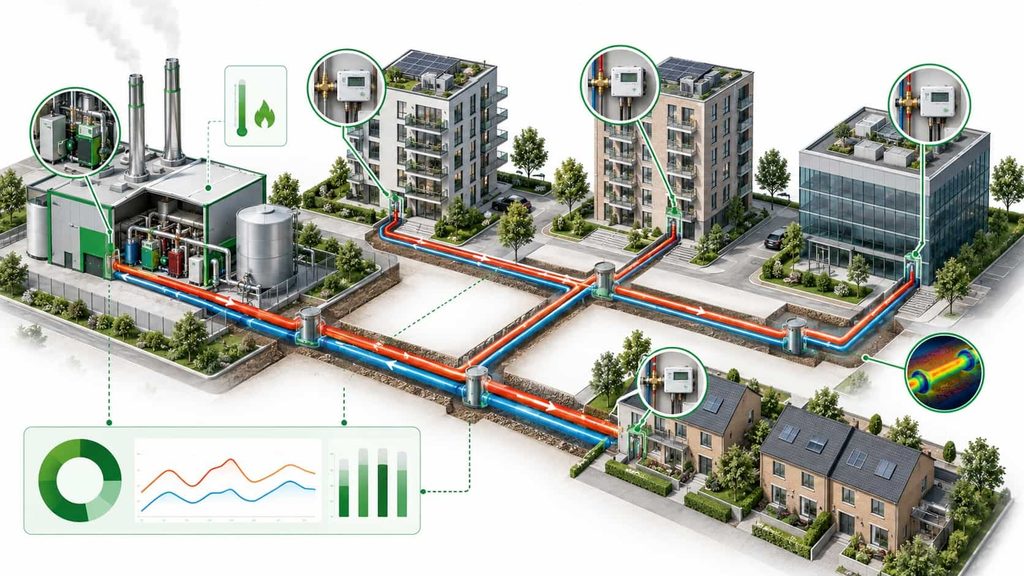
Heat meters do more than support customer billing.
They can help operators understand the performance of the network itself.
For example, meters installed at strategic points can help compare:
- Energy generated
- Energy entering the distribution network
- Energy reaching buildings
- Energy delivered to customers
Large unexplained differences may indicate distribution losses, metering problems or operational issues worth investigating.
This becomes particularly useful on large district and communal heating systems.
Heat network data should not live in separate silos
A complex network can contain many data sources.
These might include:
- Main heat meters
- Individual customer meters
- Gas meters
- Electricity meters
- Pump energy consumption
- Temperature sensors
- BMS data
- Energy-centre controls
- Billing systems
If each system is reviewed separately, understanding the network can become unnecessarily difficult.
Bringing useful information together can provide a clearer picture of both customer consumption and network performance.
This is particularly helpful where the same organisation operates several heat networks.
Meter communications need attention
Remote heat-meter reading can significantly simplify data collection.
But communications need to be reliable.
Meters may be installed inside apartments, plant rooms, risers, underground areas or other locations where communications can be difficult.
A successful metering installation therefore needs to consider how the data will leave the meter.
It may use a wired network, wireless system, gateway or another remote-reading technology.
The communication method should be designed alongside the metering system rather than added afterwards.
What happened to the previous cost-effectiveness assessment?
The 2026 changes altered the earlier approach to meter installation in Great Britain.
The former cost-effectiveness tool used under the Heat Network (Metering and Billing) Regulations is no longer used in the same way in Great Britain.
The previous building classifications were also changed.
For landlords and operators with older assessments, historic documentation should therefore be reviewed against the current requirements rather than assuming that an old classification still determines what must happen next.
Existing obligations arising from previous assessments may still matter in some circumstances.
This is one area where checking the current regulatory guidance for a particular network is especially important.
Existing meters still need to work
A heat meter should not be treated as a fit-and-forget device.
Meters can develop faults.
Batteries can fail.
Temperature sensors can become unreliable.
Communication gateways can stop transmitting.
Meters can be replaced without updating the billing system.
Properties can be renumbered or reorganised.
For networks already using metering, periodic checks should confirm that:
Meters are reporting
Readings are plausible
Meter identifiers match the correct properties
Communication systems are functioning
Billing systems are receiving the correct data
Missing readings are investigated
Replacement meters are documented
This is basic data hygiene, but it is essential when readings affect customer bills.
What about non-domestic heat-network customers?
Heat networks do not only supply homes.
They may serve offices, shops, universities, hospitals, public buildings and other non-domestic premises.
The regulatory framework includes both domestic and non-domestic heat-network activity, although some consumer-protection provisions differ depending on the customer and circumstances.
Commercial landlords should therefore not assume that heat-network regulation is relevant only to residential blocks.
Mixed-use developments deserve particular attention because they can contain several different consumer types within the same network.
Does the 2026 regime apply across the whole UK?
Ofgem’s new heat-network regulatory role applies in Great Britain, meaning England, Scotland and Wales.
Northern Ireland has separate arrangements.
For organisations operating properties across the UK, it is therefore important not to apply Great Britain guidance automatically to Northern Irish heat networks.
Data reporting is becoming part of heat-network management
The new framework also includes ongoing reporting responsibilities for regulated heat-network organisations.
This reinforces a broader point.
Heat-network regulation is becoming increasingly data-driven.
Operators need to know what networks they operate.
Suppliers need to know who their customers are.
Metering needs to produce reliable consumption information.
Billing needs to be supported by appropriate data.
Regulatory reporting requires accurate records.
Organisations managing several networks will find this much easier if information is structured and maintained centrally.
A practical heat-network readiness review
Landlords and operators preparing for the new regime should consider carrying out a basic review.
Start by identifying every communal and district heat network under the organisation’s control.
For each network, establish:
Who is the operator?
Who is the supplier?
Who are the customers?
Which meters are installed?
What does each meter measure?
Are readings collected remotely?
Where is the meter data stored?
How are bills calculated?
How are shared costs allocated?
Are any readings estimated?
Are there meters that have stopped communicating?
Who handles complaints?
Who is responsible for regulatory reporting?
Has the network been prepared for Ofgem registration?
For organisations with multiple properties, putting this information into a consistent structure can reveal gaps very quickly.
Metering is becoming part of consumer protection
The most important change in the heat-network market is not simply that there is a new regulator.
It is the expectation that customers should receive a clearer and more consistent service.
Metering sits at the centre of that relationship.
Reliable meters support consumption-based information.
Reliable data supports accurate billing.
Clear billing supports transparency.
Good monitoring helps identify faults before they become long-running problems.
For landlords and heat-network operators, this means metering should no longer be viewed simply as equipment installed in a plant room or apartment.
It is part of the information chain between the energy centre and the customer.
As regulation develops, organisations that understand their networks, meters, data and billing arrangements will be in a much stronger position than those trying to reconstruct that information after a problem occurs.